
WisPaper
Chat AssistantsWisPaper is an AI academic search tool launched by the Fudan team to improve research efficiency. Through AI search technology, it helps scholars quickly find relevant literature. Its overseas literature database search connects with mainstream academic databases such as Google Scholar, can intelligently break down questions, and through secondary verification and deep search, quickly pinpoint high-quality literature.
About
Overview
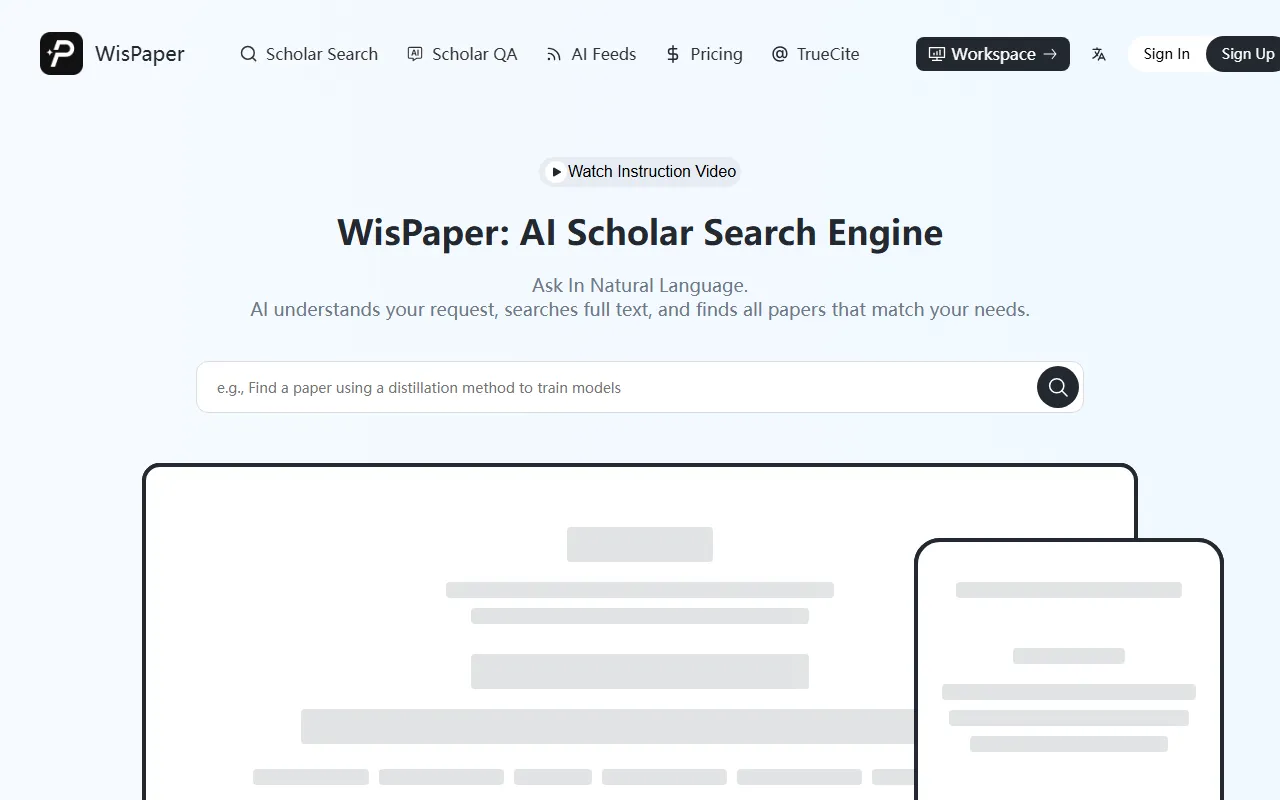
WisPaper is an AI academic search and literature reading tool designed for research scenarios, launched by the Fudan team and positioned to help researchers complete literature retrieval, screening, reading, and organization more efficiently. It supports natural language questions, can understand users' research intent, and find more relevant paper results based on full-text search and semantic analysis.
Compared with traditional keyword search, WisPaper places greater emphasis on "intent understanding" and "relevance verification": the system can intelligently break down queries, reduce interference from irrelevant results, and support marking highly relevant literature in the results, helping users lock onto target materials more quickly. In addition, the product also provides local literature database management, literature Q&A, paragraph translation, abstract refinement, and other capabilities, making it suitable for paper research, proposal preparation, review writing, and daily research reading.
Main Features
-
AI Academic Search
- Supports using natural language to describe research questions, rather than being limited to keyword input only
- Can connect with mainstream academic resources for literature retrieval
- Improves retrieval accuracy through semantic understanding, question breakdown, and deep search
- Provides highly relevant result markers for quick paper screening
-
Full-Text-Level Retrieval and Intent Matching
- Does not rely only on title or abstract matching
- Even if keywords do not appear directly in the title, it can still determine relevance by combining the main text content
- Helps discover "hidden relevant" paper materials
-
Local Knowledge Base / Literature Database Management
- Supports importing local files to build a personal research materials database
- Provides a literature management and citation organization experience similar to Zotero
- Supports retrieval and Q&A based on a personal literature database
-
AI Literature Reading
- Supports paragraph-level translation of English papers
- Allows users to ask questions about selected text and obtain explanations based on the original content
- Supports extracting core arguments, research methods, and key conclusions to generate structured summaries
-
Scholar QA and Literature Dialogue
- Users can ask questions directly around paper content
- Suitable for understanding complex concepts, comparing viewpoints, or quickly grasping article highlights
-
AI Feeds
- Attention conditions can be configured by research topic
- The system will proactively push the latest research progress and potentially important papers
- Suitable for continuously tracking frontier developments in a certain direction
Product Pricing
The official website provides an entry to the Pricing page, but the specific pricing plans are not currently shown in the captured content. Whether a free version, trial quota, or paid subscription is available is recommended to be confirmed based on the latest information on the official website: https://www.wispaper.ai/
Frequently Asked Questions
Who is WisPaper suitable for?
It is mainly suitable for university teachers, doctoral/master's students, researchers, and users who need to frequently search and read English literature.
What is the difference between WisPaper and traditional academic search?
Traditional search relies more on keyword matching; WisPaper places greater emphasis on natural language understanding, full-text retrieval, and research intent recognition, which can reduce irrelevant results and improve screening efficiency.
Does it support managing your own paper materials?
Yes. WisPaper can import local files and build a personal literature database, making it convenient for unified management, retrieval, and Q&A based on document content.
Does it support assistance for reading English papers?
Yes. It provides paragraph translation, key point summarization, and dialogue functions based on paper content, which can help users understand English literature more quickly.
Related Tools
View allOpenAI is an organization focused on artificial intelligence research and product development, offering a variety of AI capabilities including ChatGPT. Its core areas cover conversational models, generative AI, and intelligent tools for developers and general users.
OpenGPT is a tool platform for building ChatGPT applications based on APIs, supporting capabilities such as multilingual support, instant messaging, speech recognition, and natural language processing, while also providing reference application examples and open-source code.
Monica is a browser assistant based on the ChatGPT API that provides chatting, writing, translation, explanation, and rewriting functions in web environments, helping users handle text work more efficiently.
MyGPT is a ChatGPT API frontend tool that provides a built-in prompt library and chat history features, making it easier for users to handle daily conversations and prompt management in a lighter-weight way.
Merlin is a tool that brings ChatGPT capabilities to everyday web usage scenarios, helping with writing, searching, organizing information, and processing text on common websites to improve online work efficiency.
Snack Prompt is a prompt community for ChatGPT and Bard that supports discovering, liking, sharing, and organizing high-quality prompts, helping users use AI tools more efficiently.