
Lightning AI
DevelopmentLightning AI is a development framework for building and deploying models and full-stack AI applications, providing capabilities such as training, serving, and hyperparameter optimization to help developers reduce infrastructure configuration work.
About
Overview
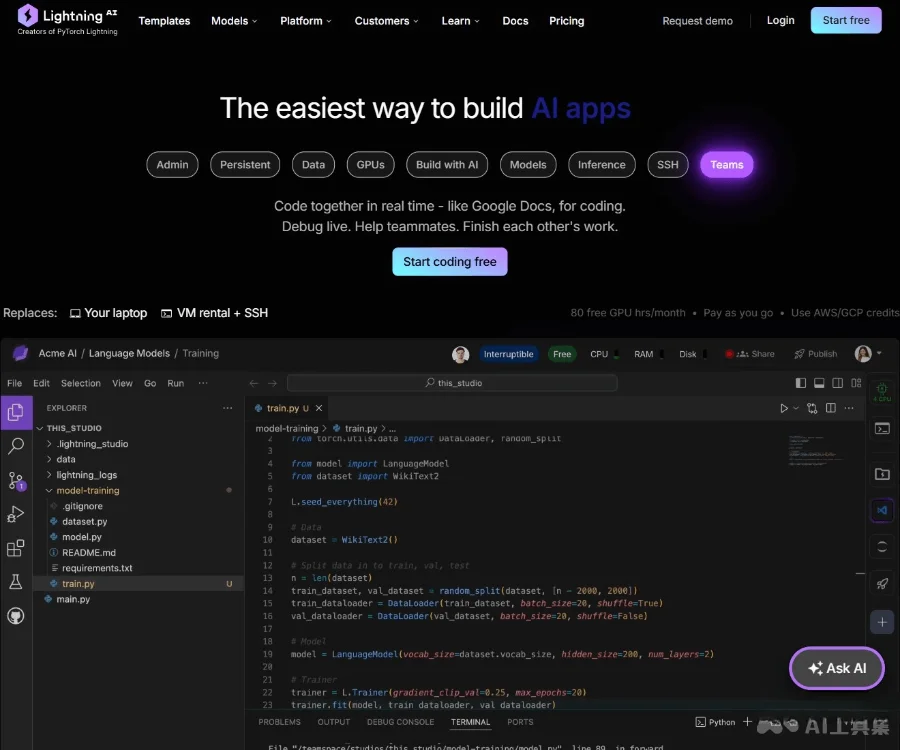
Lightning AI is an integrated AI development platform for the full process of model training, application prototyping, deployment, and serving. It was launched by the PyTorch Lightning team and emphasizes "starting from the browser, with zero configuration," helping developers reduce the burden of environment setup, infrastructure management, and scaling, so they can focus more on model capabilities and business logic implementation.
The platform is suitable for machine learning engineers, researchers, and AI product teams, and can be used to quickly build model experiments, training pipelines, and full-stack AI applications. In addition to core development capabilities, Lightning AI also provides components such as app templates, model serving, and hyperparameter optimization, making it easier to further advance experiments into deployable production scenarios.
Main Features
- End-to-end AI development workflow support: Covers prototyping, model training, scaling, deployment, and serving, making it suitable for continuous workflows from experimentation to launch.
- In-browser development: Supports development directly in the browser, reducing the cost of local environment configuration and accelerating startup.
- Lightning App templates: Can be used to build model-driven cloud applications, helping teams more quickly create AI product prototypes or internal tools.
- Model training capabilities: Supports training workflow management and is suitable for deep learning and machine learning project development.
- Model deployment and serving: Through components such as Lightning Serve, packages trained models as callable services.
- Hyperparameter optimization: Provides Lightning HPO for scalable hyperparameter search and experiment tuning.
- Collaboration and resource management: A platform-based approach helps teams share development environments and centrally manage computing resources and workflows.
- Reduced infrastructure burden: Provides a higher-level abstraction for application building, scaling, and cost control, reducing repetitive engineering work.
Pricing
Public information on the official website emphasizes providing development, training, and deployment capabilities through a platform approach, but specific pricing usually varies depending on resource usage, compute configuration, or team needs. It is recommended to visit the official website for the latest plans and billing details:
- Official website: https://lightning.ai
Frequently Asked Questions
Who is Lightning AI suitable for?
It is mainly suitable for machine learning engineers, AI researchers, data science teams, as well as startup teams or enterprise teams that need to quickly validate and launch AI products.
What are the core advantages of Lightning AI?
Its core advantage lies in integrating development, training, scaling, and serving into a unified platform, while minimizing environment configuration and infrastructure operations work as much as possible.
What types of projects can Lightning AI handle?
It can be used for model training, inference services, AI prototype applications, internal intelligent tools, and full-stack AI application development that requires front-end and back-end integration.
Is it suitable for rapid prototyping?
Yes. Its templated application capabilities and in-browser development approach help teams validate ideas more quickly and move them to a demo-ready and deployable stage.
Related Tools
View allLiner.ai is a tool that lets users build and deploy machine learning models without programming, suitable for users without a machine learning background to quickly turn training data into integrable models.
Pico is a GPT-4-based text-to-app tool that lets users quickly create simple web applications by describing their needs in natural language, making it suitable for people who have product ideas but do not have programming skills.
Imagica is a no-code AI application development platform that supports users in building AI applications without writing code, and combines real-time data with multimodal capabilities to complete interactive product design.
WidgetsAI is a no-code widget platform for building AI applications, supporting the creation, embedding, and white-labeling of AI components, suitable for teams or individuals who want to quickly integrate AI capabilities without programming.
ComfyUI is a modular graphical interface tool for Stable Diffusion that uses a node-based workflow design, making it easier for users to control the image generation process in greater detail.
Prisms AI is a no-code AI application building platform that supports connecting data sources and user input, combining models such as GPT-3, DALL·E, and Stable Diffusion to create and deploy applications.