
Pico
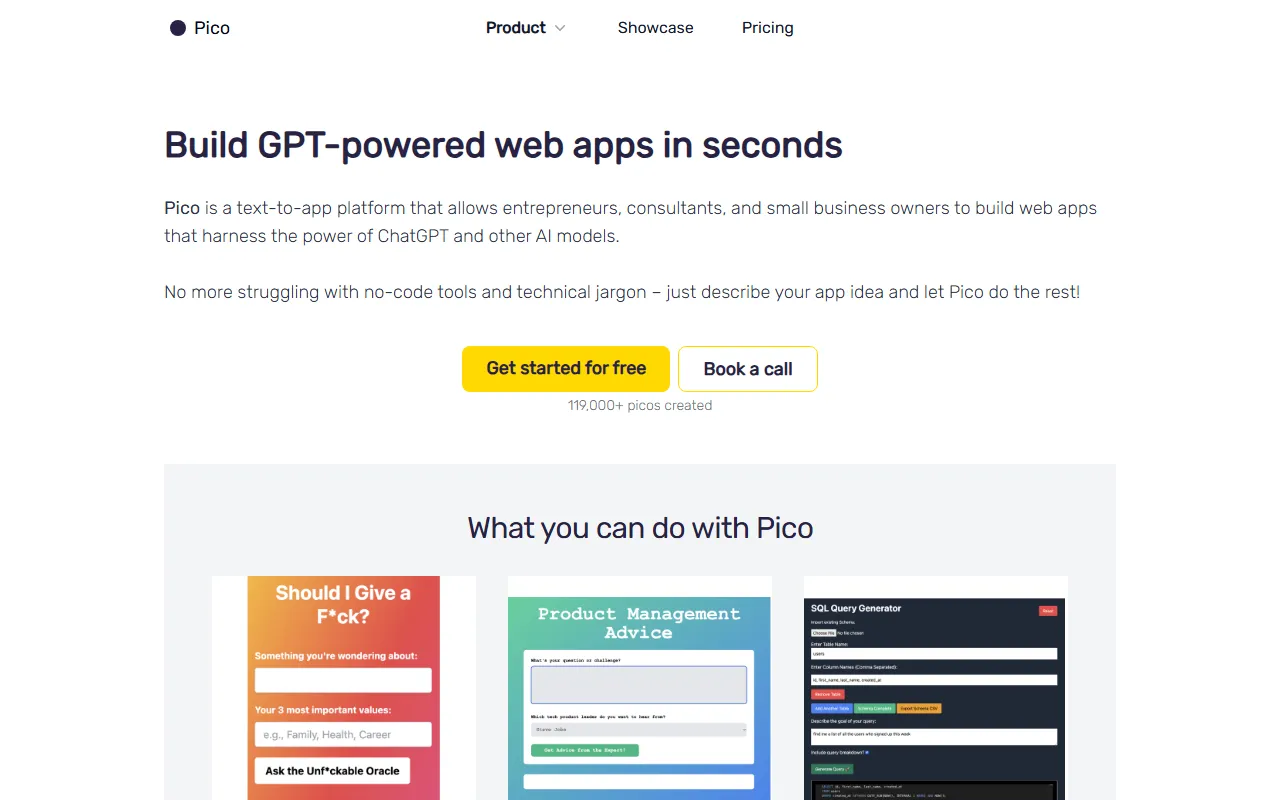
DevelopmentPico is a GPT-4-based text-to-app tool that lets users quickly create simple web applications by describing their needs in natural language, making it suitable for people who have product ideas but do not have programming skills.
About
Overview
Pico is an AI text-to-app platform designed for non-technical users, centered on the "text-to-app" creation approach. Users only need to describe the functions or page requirements they want to achieve in natural language, and the platform can use AI to help generate a simple web application prototype.
In terms of positioning, Pico is better suited for people who want to validate ideas quickly, such as entrepreneurs, consultants, small business owners, and users who do not have a programming background but have product concepts. It lowers the barrier between an idea and a usable web application, allowing users to try building lightweight tools or business pages without having to learn code from scratch.
Key Features
-
Text-to-app generation
- Users can generate simple web applications by entering requirements in natural language.
- Suitable for quickly moving from a vague idea to an actionable page or prototype.
-
Low-code / no-code experience
- Users are not required to have traditional programming skills.
- Better suited for users with non-technical backgrounds to quickly complete basic application building.
-
AI-based application building
- The product description shows that it is an AI-driven platform, and early materials mentioned that its capabilities are built on GPT-4.
- It can understand requirements based on text instructions and output the corresponding application structure.
-
Rapid prototype validation
- Suitable for testing product concepts, business processes, or internal small tools.
- It can help users validate whether an idea is feasible before formal development.
-
For lightweight web application scenarios
- It is more focused on simple web applications that can be launched quickly, rather than the development of complex large-scale systems.
- Suitable for creating demo pages, basic business tools, or concept products.
Product Pricing
Based on the currently available public information that has been collected, no clear pricing plan is shown. To find out whether it offers a free trial, subscription plans, or usage limits, it is recommended to visit the official website to check the latest page information.
Frequently Asked Questions
Who is Pico suitable for?
Pico is mainly suitable for users who do not have development experience but want to quickly create web application prototypes, such as entrepreneurs, consultants, and leaders of small teams.
Can Pico handle complex system development?
Based on the existing information, Pico is better suited to generating simple, lightweight web applications and product prototypes. If the requirements involve complex business logic, deep customization, or large-scale system construction, professional development support is still usually needed.
Do I need to know how to code to use Pico?
Usually not. Its core value lies in enabling users to complete application creation by describing requirements in natural language, thereby lowering the technical barrier.
What is Pico's core feature?
Its core feature is "generating applications with text." Users do not need to first set up a development environment or handwrite large amounts of code, and can turn ideas into web applications that can be displayed and tested more quickly.
Related Tools
View allLiner.ai is a tool that lets users build and deploy machine learning models without programming, suitable for users without a machine learning background to quickly turn training data into integrable models.
Imagica is a no-code AI application development platform that supports users in building AI applications without writing code, and combines real-time data with multimodal capabilities to complete interactive product design.
WidgetsAI is a no-code widget platform for building AI applications, supporting the creation, embedding, and white-labeling of AI components, suitable for teams or individuals who want to quickly integrate AI capabilities without programming.
ComfyUI is a modular graphical interface tool for Stable Diffusion that uses a node-based workflow design, making it easier for users to control the image generation process in greater detail.
Lightning AI is a development framework for building and deploying models and full-stack AI applications, providing capabilities such as training, serving, and hyperparameter optimization to help developers reduce infrastructure configuration work.
Prisms AI is a no-code AI application building platform that supports connecting data sources and user input, combining models such as GPT-3, DALL·E, and Stable Diffusion to create and deploy applications.