
AI Ping
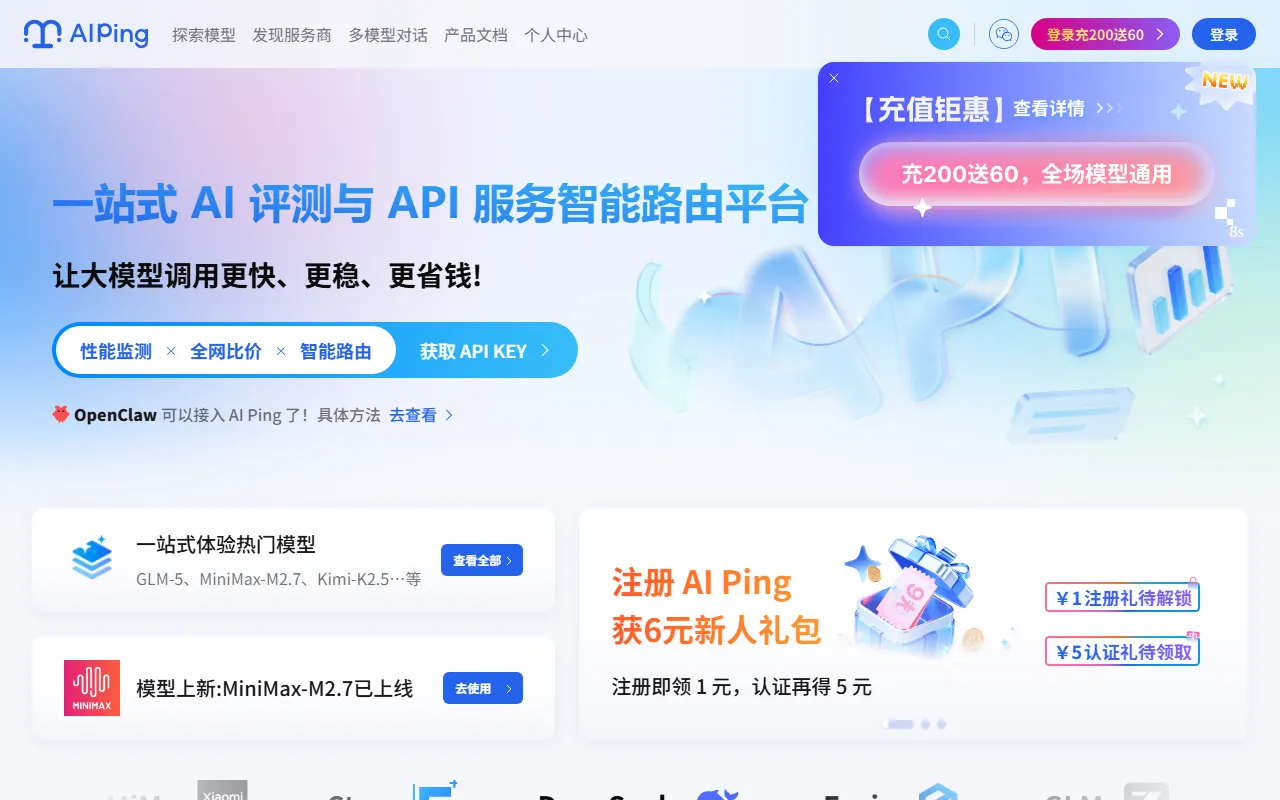
DevelopmentAI Ping is a one-stop large model service evaluation and model API calling platform. Through continuous monitoring and professional evaluations, AI Ping integrates hundreds of model services from dozens of providers, such as Wuwen Xinqiong, SophNet, and PPIO Paiou Cloud, as well as well-known models such as DeepSeek, GLM, Kimi, and Hunyuan, presenting clear performance rankings for developers and helping improve selection efficiency.
About
Overview
AI Ping is a model service evaluation and API calling platform for large model users and developers. It aggregates hundreds of model services from dozens of providers and offers continuously monitored evaluation data, helping users compare the performance of different models and service providers across dimensions such as latency, throughput, and stability, thereby improving selection efficiency.
In addition to evaluation capabilities, AI Ping also provides a unified API interface and intelligent routing capabilities. Developers can call multiple model services through a single access method, reducing the cost of adapting to multiple platforms; during calls, the platform matches providers based on real-time conditions to balance performance, success rate, and cost.
Key Features
-
Model performance evaluation rankings
Provides long-cycle, high-frequency, multi-period evaluation data covering the core metrics of large model services, making it easier for developers and enterprises to quickly judge model service quality. -
Multi-provider model aggregation
Integrates multiple model service providers and mainstream models. Users can view model information, service summaries, and evaluation results on the same platform, reducing the time cost of fragmented searches. -
Unified API interface
Call model services from multiple providers through one interface, reducing integration complexity and making it suitable for development scenarios that require frequent switching or horizontal testing of models. -
Intelligent routing and scheduling
Automatically selects more suitable providers based on real-time data and strategies, dynamically balancing performance, cost, and availability, and supports failover. -
Call data statistics
Provides data reports related to API calls, including information such as models, providers, token consumption, and costs, helping teams carry out cost management and usage analysis.
Product Pricing
At present, there is no clearly stated unified pricing information in the publicly available information. Since AI Ping provides both model evaluation and aggregated API calling services, actual costs may depend on the selected model, provider, and call volume. It is recommended to register on the official website and then check the latest billing information in the console or interface documentation.
FAQ
Which users is AI Ping suitable for?
It is suitable for enterprise teams that need to select large models, developers who need unified access to multi-model APIs, as well as researchers and testers who pay attention to model service performance.
What is the core value of AI Ping?
Its core value lies in combining model evaluation with model calling: on the one hand, it helps users clearly see the actual performance of different providers; on the other hand, it reduces the engineering cost of accessing and switching models.
Can model APIs be called directly?
Yes. The platform provides a unified API interface and gives examples of common calling methods, such as Python SDK, Requests, or Curl, making it convenient for developers to integrate quickly.
Related Tools
View allLiner.ai is a tool that lets users build and deploy machine learning models without programming, suitable for users without a machine learning background to quickly turn training data into integrable models.
Pico is a GPT-4-based text-to-app tool that lets users quickly create simple web applications by describing their needs in natural language, making it suitable for people who have product ideas but do not have programming skills.
Imagica is a no-code AI application development platform that supports users in building AI applications without writing code, and combines real-time data with multimodal capabilities to complete interactive product design.
WidgetsAI is a no-code widget platform for building AI applications, supporting the creation, embedding, and white-labeling of AI components, suitable for teams or individuals who want to quickly integrate AI capabilities without programming.
ComfyUI is a modular graphical interface tool for Stable Diffusion that uses a node-based workflow design, making it easier for users to control the image generation process in greater detail.
Lightning AI is a development framework for building and deploying models and full-stack AI applications, providing capabilities such as training, serving, and hyperparameter optimization to help developers reduce infrastructure configuration work.