
About
Overview
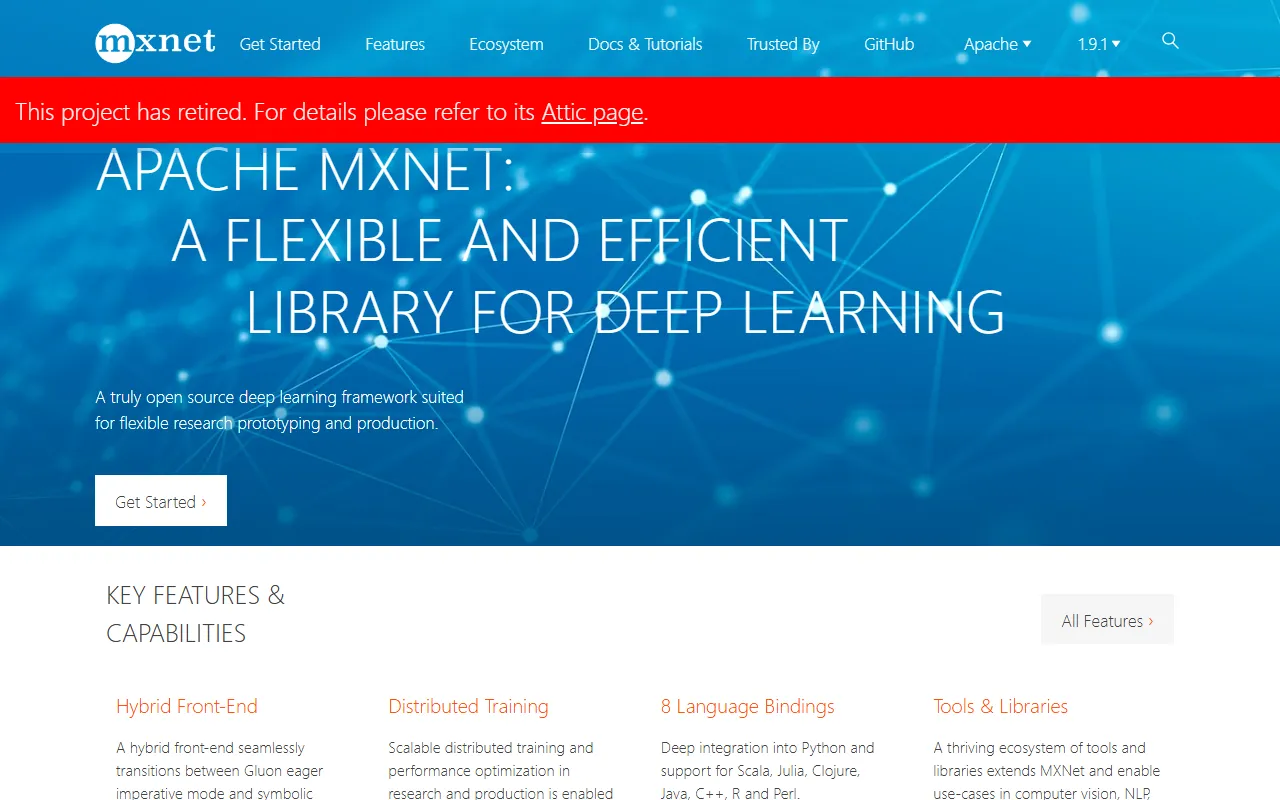
Apache MXNet is a free and open-source deep learning framework maintained by the Apache Foundation, aimed at research prototyping and production deployment scenarios. The official website positions it as a "flexible and efficient deep learning library," emphasizing a balance among flexibility, training efficiency, and engineering capabilities.
MXNet is suitable for developers and researchers who need to build, train, and deploy deep learning models. It supports workflows from rapid experimentation to large-scale distributed training, and provides multi-language interfaces for easy integration into different technology stacks.
Key Features
-
Flexible and efficient deep learning framework
- Supports rapid prototype validation in research scenarios and is also suitable for deployment in production environments.
- Balances ease of use and performance, making it suitable for model development needs at different scales.
-
Hybrid Front-End
- Can switch between Gluon's imperative (eager imperative) mode and symbolic mode.
- Provides development flexibility while also taking execution speed and deployment efficiency into account.
-
Distributed training capabilities
- Supports scalable distributed training and performance optimization.
- The official website mentions support for Parameter Server and Horovod, making it suitable for multi-machine and multi-GPU training scenarios.
-
Multi-language bindings
- Provides 8 language bindings, making access convenient for developers in different programming language ecosystems.
- This makes it easier to integrate into existing data processing, training, and deployment workflows.
-
Open-source ecosystem
- Released in an open-source manner, allowing developers to freely view, use, and participate in community collaboration.
- Suitable for teams that want to carry out deep learning development on a controllable technology stack.
Pricing
- Free
- Open source
- Can be used and learned directly through the official website and open-source community resources.
Suitable For
- Deep learning researchers
- Engineering teams that need to train and deploy models
- Developers who want to conduct distributed training
- AI development projects that need multi-language support
Frequently Asked Questions
What scenarios is Apache MXNet suitable for?
It is suitable for research, prototype development, training optimization, and production deployment of deep learning models, especially for scenarios that value both development flexibility and training efficiency.
Is Apache MXNet open source?
Yes. Apache MXNet is an open-source deep learning framework under Apache and can be used for free.
Does Apache MXNet support distributed training?
Yes. According to the official website, MXNet provides support for Parameter Server and Horovod, which can be used for scalable distributed training.
What are the features of Apache MXNet?
Its core features include a hybrid front-end, distributed training capabilities, multi-language bindings, and flexibility for both research and production scenarios.
Related Tools
View allLiner.ai is a tool that lets users build and deploy machine learning models without programming, suitable for users without a machine learning background to quickly turn training data into integrable models.
Pico is a GPT-4-based text-to-app tool that lets users quickly create simple web applications by describing their needs in natural language, making it suitable for people who have product ideas but do not have programming skills.
Imagica is a no-code AI application development platform that supports users in building AI applications without writing code, and combines real-time data with multimodal capabilities to complete interactive product design.
WidgetsAI is a no-code widget platform for building AI applications, supporting the creation, embedding, and white-labeling of AI components, suitable for teams or individuals who want to quickly integrate AI capabilities without programming.
ComfyUI is a modular graphical interface tool for Stable Diffusion that uses a node-based workflow design, making it easier for users to control the image generation process in greater detail.
Lightning AI is a development framework for building and deploying models and full-stack AI applications, providing capabilities such as training, serving, and hyperparameter optimization to help developers reduce infrastructure configuration work.