
Caffe
DevelopmentA deep learning framework introduced by UC Berkeley research
About
Overview
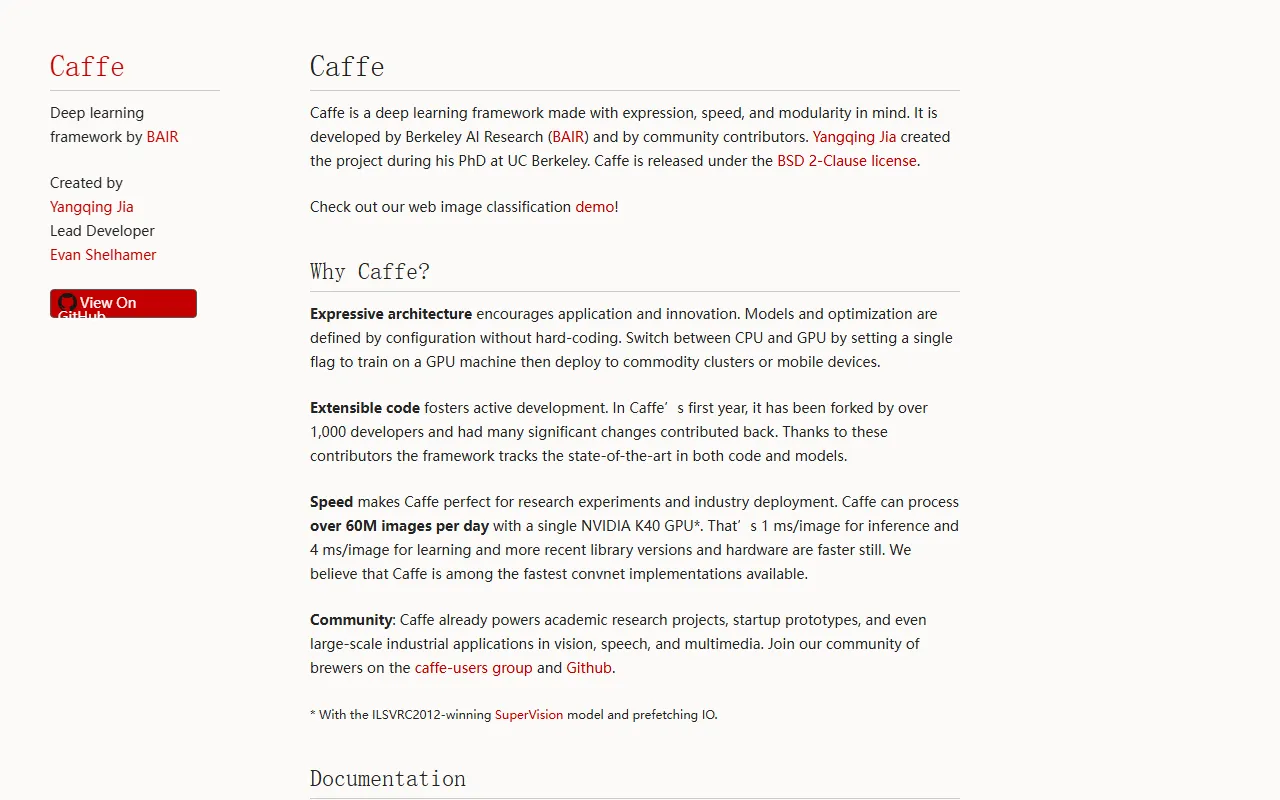
Caffe (Convolutional Architecture for Fast Feature Embedding) is an open-source deep learning framework initiated by Yangqing Jia at UC Berkeley during his PhD, and later jointly maintained by Berkeley AI Research (BAIR) and the community. With clear expression, efficient execution, and strong modularity as its core design goals, it was once widely used in research and industrial scenarios related to computer vision, speech, and multimedia.
One major feature of Caffe is that it uses configuration-based definitions for models and optimization processes, rather than hard-coding network structures into programs, which makes experimental iteration and model reproduction more convenient. The official website emphasizes that Caffe can switch between CPU and GPU by changing a single setting, making it convenient for training, deployment, and migration to different hardware environments.
It should be noted that Facebook later introduced Caffe2 as a subsequent evolved version, which was merged into PyTorch in 2018. Therefore, Caffe is more suitable for understanding the design of classic deep learning frameworks, maintaining existing projects, or studying early convolutional neural network workflows.
Main Features
-
Open-source deep learning framework
- Released under the BSD 2-Clause License and can be freely used for research and development.
-
Efficient implementation for convolutional neural networks
- It was strong in computer vision tasks in its early years and is suitable for CNN applications such as image classification.
-
Configuration-driven model definition
- Uses configuration files to describe model structures and optimization parameters, reducing hard-coding and facilitating experiment management.
-
Supports CPU / GPU switching
- Can switch between different computing environments through simple settings, making training and deployment convenient.
-
Emphasizes speed and engineering usability
- Officially described as having high inference and training efficiency, suitable for research experiments and industrial deployment.
-
Modular and extensible architecture
- The code structure is clear, making it easy for developers to extend network layers, training workflows, and related components.
-
Has an academic and community foundation
- Driven by Berkeley research teams, and has accumulated experience from many research projects and community contributions.
Pricing
Caffe is a free and open-source project, and the official site does not provide a commercial subscription pricing page.
Users can directly obtain the source code, documentation, and related resources through the official website and GitHub, and deploy and use it on their own.
FAQ
Who is Caffe suitable for?
It is suitable for deep learning researchers, computer vision developers, engineering teams that need to maintain legacy Caffe projects, and learners who want to understand the design approach of classic deep learning frameworks.
What are Caffe's advantages?
Its main advantages are fast speed, clear structure, and convenient configuration-based modeling, making it especially suitable for early CNN research and engineering deployment scenarios.
Are Caffe and Caffe2 the same project?
No. Caffe is the original open-source deep learning framework; Caffe2 is a later version introduced by Facebook, which has since been merged into PyTorch.
Is Caffe still worth using now?
If you are maintaining old projects, learning classic framework design, or handling models and workflows that depend on Caffe, it still has value; if it is a new project, from the perspective of ecosystem and long-term maintenance, modern frameworks such as PyTorch are usually considered more often.
Official Link
- Official website: https://caffe.berkeleyvision.org/
Related Tools
View allLiner.ai is a tool that lets users build and deploy machine learning models without programming, suitable for users without a machine learning background to quickly turn training data into integrable models.
Pico is a GPT-4-based text-to-app tool that lets users quickly create simple web applications by describing their needs in natural language, making it suitable for people who have product ideas but do not have programming skills.
Imagica is a no-code AI application development platform that supports users in building AI applications without writing code, and combines real-time data with multimodal capabilities to complete interactive product design.
WidgetsAI is a no-code widget platform for building AI applications, supporting the creation, embedding, and white-labeling of AI components, suitable for teams or individuals who want to quickly integrate AI capabilities without programming.
ComfyUI is a modular graphical interface tool for Stable Diffusion that uses a node-based workflow design, making it easier for users to control the image generation process in greater detail.
Lightning AI is a development framework for building and deploying models and full-stack AI applications, providing capabilities such as training, serving, and hyperparameter optimization to help developers reduce infrastructure configuration work.