
Devin
DevelopmentDevin is the world's first fully autonomous AI software engineer agent launched by AI startup Cognition, with strong programming and software development capabilities. It can assist with or independently complete software development tasks in multiple areas. In the SWE-bench benchmark, Devin significantly outperformed AI models such as GPT-4 and Claude 2 in solving real-world problems.
About
Overview
Devin is an AI software engineering agent launched by Cognition, positioned as a “cloud development agent” that can collaborate with engineering teams. It can not only generate code, but also execute tasks around real development workflows, such as reading documentation, understanding codebases, breaking down requirements, submitting changes, and handling to-do items. Compared with traditional code completion tools, Devin places more emphasis on task-level execution and continuous collaboration capabilities.
According to officially disclosed early information, Devin once achieved leading performance in software engineering benchmark tests such as SWE-bench, which are oriented toward real GitHub Issues, demonstrating its potential in understanding problems, modifying code, and solving practical engineering tasks. Combined with the latest updates from the official website, Devin has now further developed into a cloud agent platform for engineering teams, supporting more complex task orchestration and continuous operation.
Key Features
- Task-level software development collaboration: It can receive development tasks like a team member and carry out specific work around a codebase.
- Reading documentation and learning new technologies: It can understand unfamiliar technology stacks or project structures by reading documentation, code, and context.
- End-to-end development workflow support: It covers the complete process from requirement understanding, coding, and debugging to submitting results, making it suitable for handling relatively complete software engineering tasks.
- Bug fixing and code maintenance: It can be used to locate issues, fix defects, and assist in handling legacy tasks in projects.
- Open-source and production environment contributions: It is suitable for fixing issues in open-source repositories and can also participate in feature iteration and maintenance of mature codebases.
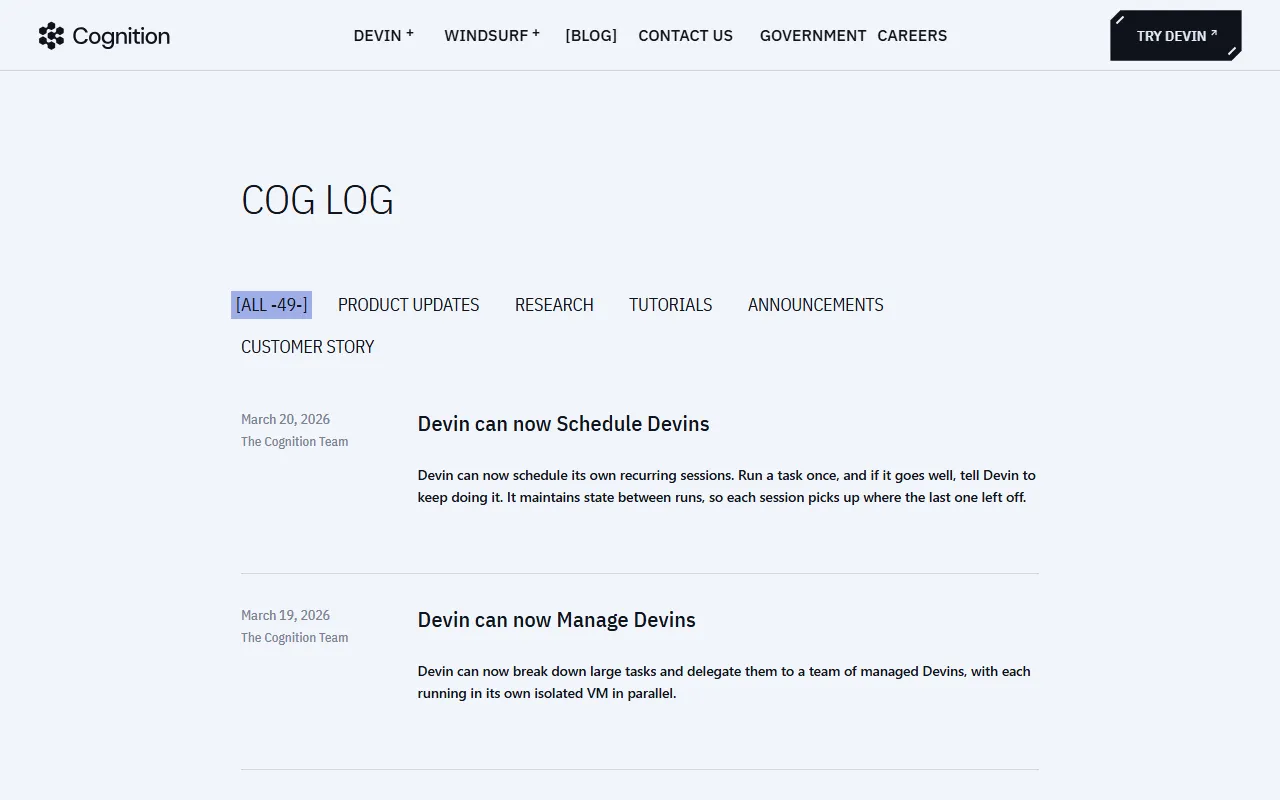
- Parallel task management: According to the latest updates from the official website, Devin now supports splitting large tasks and delegating them to multiple independently running Devin instances for parallel processing.
- Scheduled and continuous execution: It supports arranging recurring sessions and maintaining state across multiple runs, making it suitable for repetitive engineering tasks.
Product Pricing
At present, the official blog page does not provide clear public pricing information. Devin's functions and product form are still being continuously updated, and for specific availability, plan options, and access methods, it is recommended to refer to the latest information on Cognition's official pages.
Frequently Asked Questions
Who is Devin suitable for?
It is more suitable for R&D teams, software engineers, technical leads, and organizations that need to handle code maintenance, task assignment, and development automation.
What is the difference between Devin and ordinary AI coding assistants?
Ordinary AI coding tools usually focus on code completion, Q&A, or snippet generation; Devin places more emphasis on continuous execution around real engineering tasks, such as understanding repositories, handling to-dos, submitting changes, and parallel collaboration.
Is Devin already fully open for use?
Based on currently available public information, Devin was for a long time in private testing and gradual rollout stages. The latest feature updates are currently frequent, and the actual scope of availability should be based on official release notes.
Related Tools
View allLiner.ai is a tool that lets users build and deploy machine learning models without programming, suitable for users without a machine learning background to quickly turn training data into integrable models.
Pico is a GPT-4-based text-to-app tool that lets users quickly create simple web applications by describing their needs in natural language, making it suitable for people who have product ideas but do not have programming skills.
Imagica is a no-code AI application development platform that supports users in building AI applications without writing code, and combines real-time data with multimodal capabilities to complete interactive product design.
WidgetsAI is a no-code widget platform for building AI applications, supporting the creation, embedding, and white-labeling of AI components, suitable for teams or individuals who want to quickly integrate AI capabilities without programming.
ComfyUI is a modular graphical interface tool for Stable Diffusion that uses a node-based workflow design, making it easier for users to control the image generation process in greater detail.
Lightning AI is a development framework for building and deploying models and full-stack AI applications, providing capabilities such as training, serving, and hyperparameter optimization to help developers reduce infrastructure configuration work.