
GPUX.AI
DevelopmentGPUX.AI provides resource services for GPU computing tasks, supports running various GPU applications in Docker containers, and offers automatically scalable inference capabilities.
About
Overview
GPUX.AI is a GPU computing service platform for AI development and programming scenarios, mainly providing on-demand GPU/CPU computing power for tasks such as deep learning, machine learning, image processing, and model inference. Its core approach is to enable developers to run various GPU applications based on Docker containers, thereby reusing existing containerized deployment workflows and lowering the barriers to environment setup and launch.
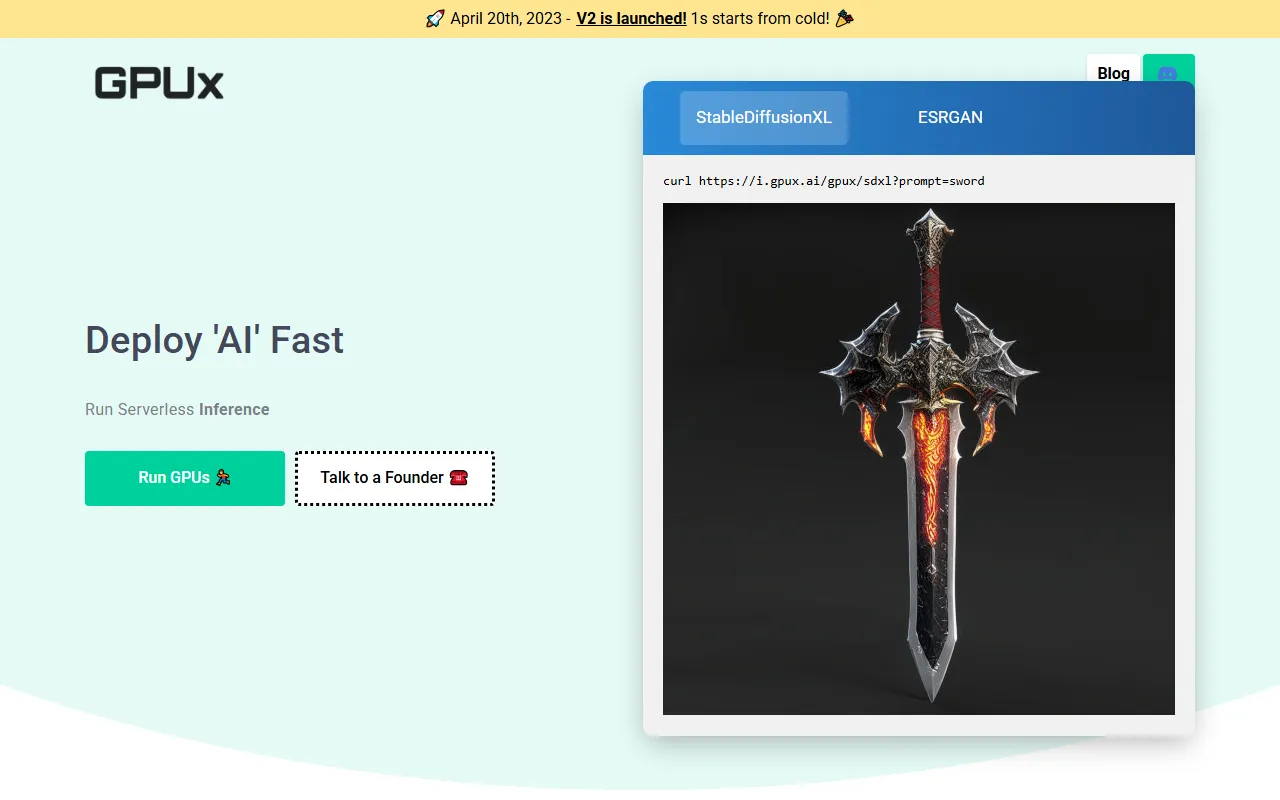
Based on publicly available information from the official website, GPUX emphasizes Serverless Inference, cold start speed, and elastic scaling capabilities, making it suitable for business scenarios with large fluctuations in inference requests. The platform also showcases typical AI inference application cases such as Stable Diffusion XL, Whisper, and ESRGAN, indicating that it is more oriented toward providing infrastructure support for model deployment, inference services, and GPU-intensive tasks.
Main Features
-
GPU/CPU computing resource provisioning
- Supports computing tasks such as deep learning, machine learning, and image processing.
- Suitable for testing, inference, and running other GPU-intensive programs.
-
Docker-based GPU application runtime
- Supports deploying and running any GPU application in Docker containers.
- Makes it easier for developers to reuse existing container images and deployment workflows.
-
Serverless inference capabilities
- The official website explicitly provides “Fast Run Serverless Inference”.
- More suitable for inference tasks triggered on request, rather than deployment methods that occupy resources on a long-term fixed basis.
-
Automatic scaling
- Supports elastic scaling based on changes in inference workload.
- Helps handle model service scenarios with traffic peaks or large request fluctuations.
-
Fast cold starts
- The official website mentions that the V2 version supports “1s starts from cold”.
- More friendly for inference interfaces with short-term calls or low-frequency access.
-
Model inference and example coverage
- The official website showcases StableDiffusionXL, Whisper, ESRGAN, and some LLM-related content.
- This indicates that the platform is suitable for inference tasks such as text-to-image generation, speech recognition, and image enhancement.
-
Documentation and web entry points
- Provides browser-side pages and documentation entry points, making it convenient for developers to understand access and usage methods.
Pricing
At present, the official website content that was captured does not clearly display a standardized pricing page or package prices.
For this type of GPU resource and inference service platform, actual costs may usually be related to the following factors:
- Type of GPU/CPU resources used
- Volume of inference requests and runtime duration
- Container deployment method
- Whether automatic scaling and persistent storage are involved
For accurate pricing, it is recommended to visit the official website directly or contact the official team for further confirmation.
FAQ
-
Which users is GPUX.AI suitable for?
- It is suitable for developers and teams that need to deploy model inference services, run GPU container tasks, or call computing power on demand.
-
Does it support custom application deployment?
- Based on the current introduction, the platform supports running any GPU application in Docker containers, so it has strong flexibility for custom deployment.
-
Is it more suitable for training or inference?
- Judging from the latest content on the official website, GPUX places greater emphasis on inference services, Serverless Inference, and elastic scaling, so it is more oriented toward inference scenarios.
-
Is there public documentation?
- Yes, the official website provides documentation and application entry points, which can be used to further understand the product's access methods and usage process.
Related Tools
View allLiner.ai is a tool that lets users build and deploy machine learning models without programming, suitable for users without a machine learning background to quickly turn training data into integrable models.
Pico is a GPT-4-based text-to-app tool that lets users quickly create simple web applications by describing their needs in natural language, making it suitable for people who have product ideas but do not have programming skills.
Imagica is a no-code AI application development platform that supports users in building AI applications without writing code, and combines real-time data with multimodal capabilities to complete interactive product design.
WidgetsAI is a no-code widget platform for building AI applications, supporting the creation, embedding, and white-labeling of AI components, suitable for teams or individuals who want to quickly integrate AI capabilities without programming.
ComfyUI is a modular graphical interface tool for Stable Diffusion that uses a node-based workflow design, making it easier for users to control the image generation process in greater detail.
Lightning AI is a development framework for building and deploying models and full-stack AI applications, providing capabilities such as training, serving, and hyperparameter optimization to help developers reduce infrastructure configuration work.