
About
Overview
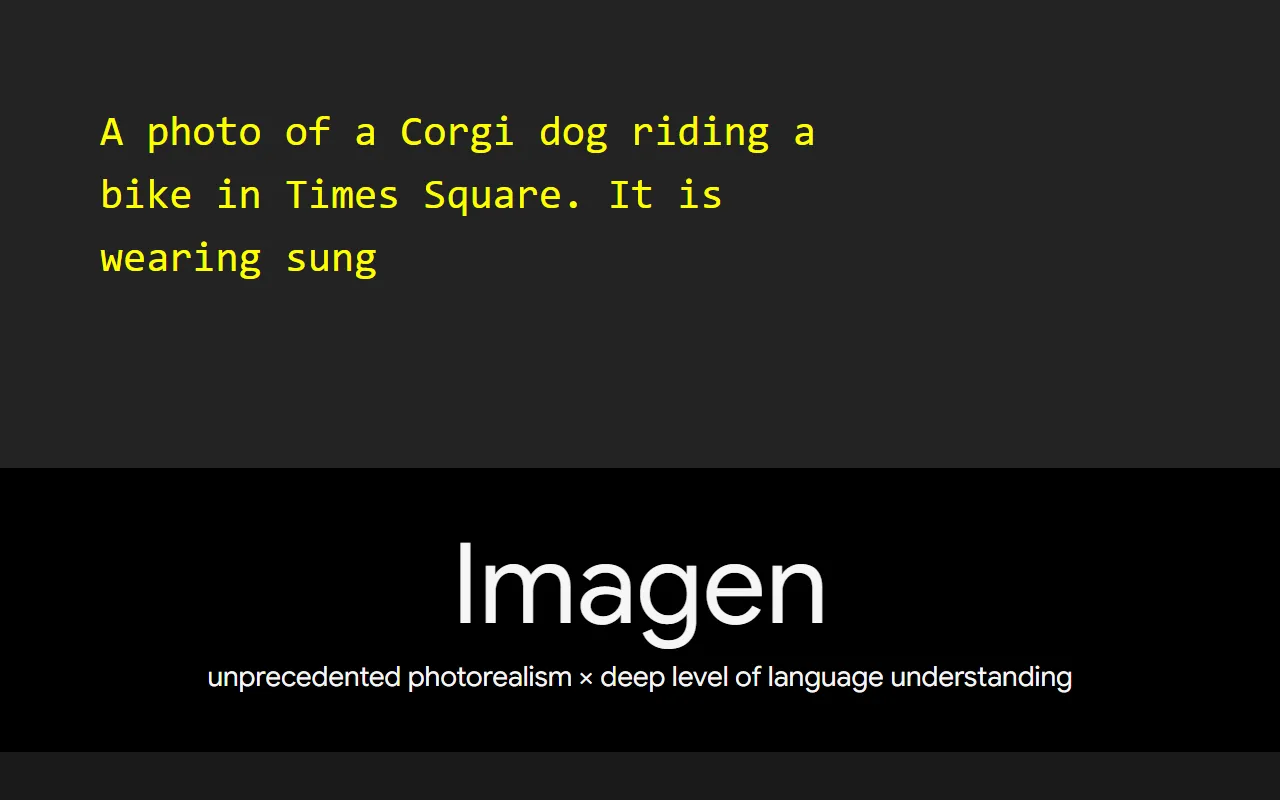
Imagen is a text-to-image model released by Google Research and is a text-to-image research project based on diffusion models. Its core goal is to generate high-quality, semantically consistent image content from natural language prompts. The official website title is "Imagen: Text-to-Image Diffusion Models", which shows that it is positioned more as a showcase of cutting-edge research results rather than a complete commercial product for the general public.
Compared with traditional image generation methods, Imagen places emphasis on understanding textual semantics, as well as the performance of generated images in detail, realism, and text-image correspondence. This project is mainly used to demonstrate Google's research progress in text-to-image generation and also reflects the capability boundaries of combining large-scale language understanding with diffusion models.
Main Features
-
Text-to-image generation
- Generate corresponding images based on natural language descriptions entered by users.
- Suitable for research on text-conditioned image generation tasks.
-
Generation framework based on diffusion models
- Uses diffusion models for image synthesis, gradually reconstructing image content from noise.
- This type of method usually has advantages in image quality and detail performance.
-
Emphasis on text semantic alignment
- The model focuses on improving the semantic consistency between images and prompts.
- Suitable for evaluating "prompt understanding ability" and "generation result accuracy."
-
Research showcase and paper reference
- The official website content mainly consists of papers, author information, and research results.
- It has reference value for developers and researchers interested in AI image generation, diffusion models, and multimodal research.
-
Responsible AI practices
- From the summary on the official website, it can be seen that the project team mentioned incorporating responsible AI practices during the R&D process.
- This indicates that the project also pays attention to the impact of generative models in terms of safety and application.
Pricing
Based on the public information currently available on the official website, Imagen is mainly presented as a research project, and does not clearly provide standalone subscription pricing for ordinary users or a public commercial pricing page.
If you are concerned with the actual productized services for Google's image generation capabilities, you usually need to further check the latest access instructions and billing rules for platforms such as Google Cloud, Vertex AI, or Gemini.
Frequently Asked Questions
Can Imagen be used directly online?
The official website currently leans more toward a page introducing research results, rather than a typical online creation tool interface. Whether it can be experienced directly depends on Google's subsequent official availability method.
What type of AI tool is Imagen?
It falls under the category of AI development and programming / generative AI / text-to-image model, and is especially suitable for developers and researchers focused on multimodal generation and diffusion models.
Is Imagen a commercial tool or a research project?
Based on the current public page, it is closer to a research project. What it showcases is Google Research's model achievements in text-to-image generation, rather than an independent and complete consumer-facing application.
What is Imagen's core value?
Its core value lies in verifying and demonstrating that by combining strong text understanding capabilities with diffusion models, it is possible to generate higher-quality image results that are more consistent with text descriptions. This is of great significance for research in generative AI, visual understanding, and multimodal systems.
Related Tools
View allLiner.ai is a tool that lets users build and deploy machine learning models without programming, suitable for users without a machine learning background to quickly turn training data into integrable models.
Pico is a GPT-4-based text-to-app tool that lets users quickly create simple web applications by describing their needs in natural language, making it suitable for people who have product ideas but do not have programming skills.
Imagica is a no-code AI application development platform that supports users in building AI applications without writing code, and combines real-time data with multimodal capabilities to complete interactive product design.
WidgetsAI is a no-code widget platform for building AI applications, supporting the creation, embedding, and white-labeling of AI components, suitable for teams or individuals who want to quickly integrate AI capabilities without programming.
ComfyUI is a modular graphical interface tool for Stable Diffusion that uses a node-based workflow design, making it easier for users to control the image generation process in greater detail.
Lightning AI is a development framework for building and deploying models and full-stack AI applications, providing capabilities such as training, serving, and hyperparameter optimization to help developers reduce infrastructure configuration work.