
JamGPT
DevelopmentJamGPT is the latest AI debugging assistant launched by bug reporting tool Jam. JamGPT helps developers analyze all the details of bug reports and find relevant causes and solutions before you even start reading.
About
Overview
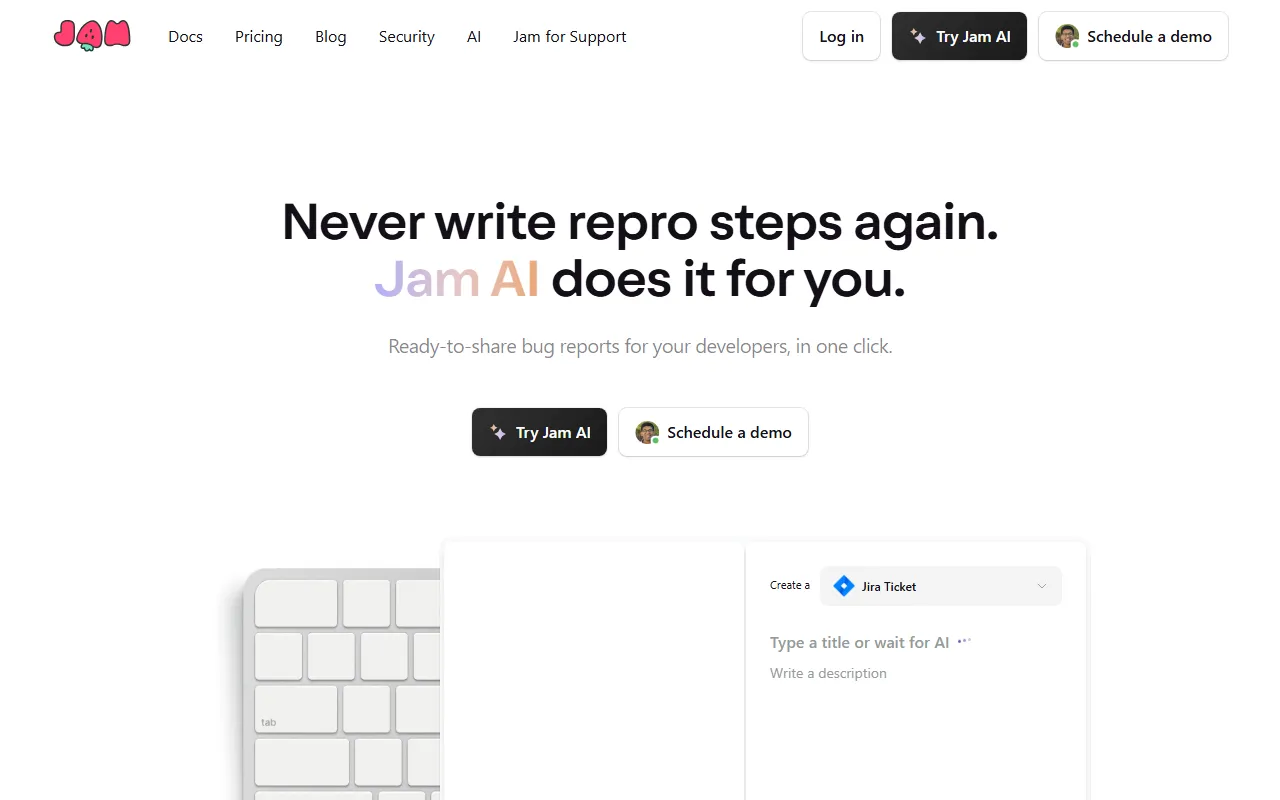
JamGPT is an AI debugging assistant launched by Jam, designed for development and bug troubleshooting scenarios, helping teams identify the causes of issues faster and organize repair clues based on bug reports. Based on the latest information from the official website, Jam's AI can automatically complete bug titles, descriptions, and reproduction steps, and combine this with a one-click ticket creation workflow to reduce the time cost of manually organizing issue information.
For developers, testers, and product teams, the core value of JamGPT/Jam AI lies in automatically organizing more complete contextual information when submitting bugs, allowing developers to get clearer issue descriptions before reading the report, thereby improving troubleshooting and collaboration efficiency.
Key Features
-
AI Automatically Generates Bug Titles
Automatically generates more accurate titles based on recorded content and context, helping developers quickly understand the issue topic. -
AI Automatically Writes Reproduction Steps
Automatically generates reproduction paths, reducing the workload of writing steps by hand and improving the clarity and consistency of bug reports. -
Automatically Generates Issue Descriptions
Completes description information when creating bugs, making it easier for development teams to quickly understand abnormal behavior and background. -
Automatic Screen Recording and Log Collection
Jam can record on-screen actions and automatically capture relevant logs when submitting issues, reducing the probability of missing information. -
Assisted Debugging and Issue Analysis
Based on existing bug report content, helps developers analyze details and provide possible causes and repair directions. -
Code Snippet Analysis and Fix Suggestions
Supports pasting code snippets for analysis and obtaining suggestions related to the current issue for use in the debugging workflow. -
Integration with Ticketing Systems
Can push bugs with one click to tools such as Jira, Linear, Notion, reducing copy-pasting and duplicate entry. -
Supports Team Collaboration
Suitable for collaborative communication among product, testing, and development teams, making issue information more complete and shareable at the time of submission. -
Focuses on Code and Data Security
The official introduction mentions that it pays attention to repository privacy and security during the debugging process, making it suitable for teams with security requirements.
Pricing
The current content on the official website shows that Jam AI offers a free trial, but the publicly available information does not show complete pricing plans and package details. If you need to learn about the enterprise version, team version, or specific feature limitations, it is recommended to visit the official website page or contact the official demo.
FAQ
-
Where can Jam's AI features be used?
According to the official website, Jam's AI features are available when creating Jam reports and can be used directly in the bug submission process. -
Is Jam AI free?
The official website shows that it can be tried, but the current public information does not fully display the detailed differences between the free and paid versions. -
Who is JamGPT suitable for?
It is mainly suitable for developers, testers, product managers, and teams that need to submit and handle bugs efficiently. -
What is JamGPT's core advantage?
The focus is on automatically generating titles, descriptions, and reproduction steps, and combining screen recording, log collection, and ticketing integration to improve bug report quality and processing efficiency.
Related Tools
View allLiner.ai is a tool that lets users build and deploy machine learning models without programming, suitable for users without a machine learning background to quickly turn training data into integrable models.
Pico is a GPT-4-based text-to-app tool that lets users quickly create simple web applications by describing their needs in natural language, making it suitable for people who have product ideas but do not have programming skills.
Imagica is a no-code AI application development platform that supports users in building AI applications without writing code, and combines real-time data with multimodal capabilities to complete interactive product design.
WidgetsAI is a no-code widget platform for building AI applications, supporting the creation, embedding, and white-labeling of AI components, suitable for teams or individuals who want to quickly integrate AI capabilities without programming.
ComfyUI is a modular graphical interface tool for Stable Diffusion that uses a node-based workflow design, making it easier for users to control the image generation process in greater detail.
Lightning AI is a development framework for building and deploying models and full-stack AI applications, providing capabilities such as training, serving, and hyperparameter optimization to help developers reduce infrastructure configuration work.