
JAX
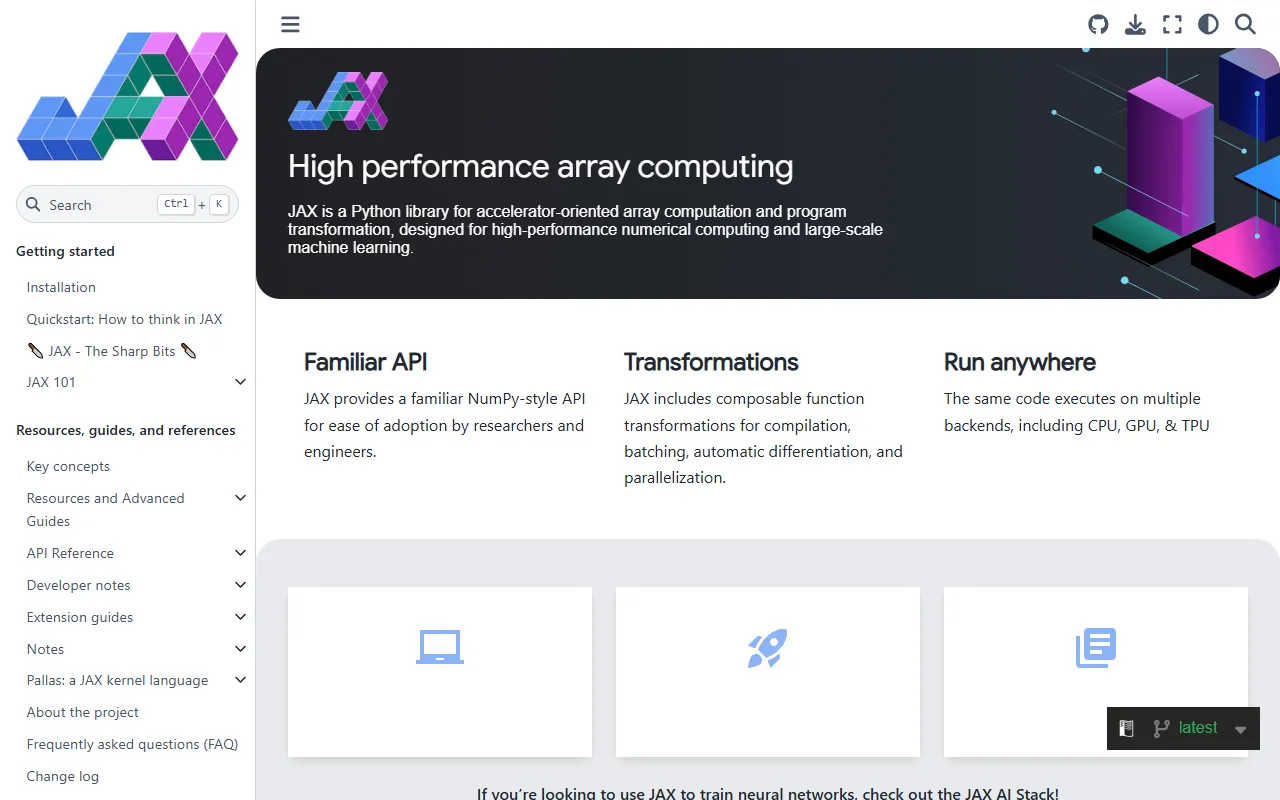
DevelopmentJAX is a high-performance numerical computing library launched by Google, providing a NumPy-like API and supporting GPU/TPU acceleration, automatic differentiation, just-in-time compilation (JIT), and vectorization.
About
Overview
JAX is a high-performance numerical computing library launched by Google, designed for scientific computing, machine learning, and large-scale array operations. It provides an API highly similar to NumPy, making it easy for existing Python research and engineering users to get started quickly, while also enabling efficient optimization through the XLA compiler so the same code can run on CPU, GPU, and TPU.
Compared with traditional NumPy, JAX’s core advantages are not limited to “array computing,” but also include a complete set of composable program transformation capabilities, such as automatic differentiation, just-in-time compilation, batch vectorization, and multi-device parallelization. This makes it very suitable for building high-performance training workflows, optimization algorithms, and scientific simulation programs.
Main Features
-
NumPy-style API
Provides thejax.numpyinterface, with syntax conventions close to NumPy, so the migration cost is relatively low. -
Automatic differentiation
Supports gradient computation using tools such asjax.grad, and can also handle more complex derivative requirements, making it suitable for model training and numerical optimization. -
Just-in-time compilation (JIT)
Usesjax.jitto compile Python functions into efficiently executable code, which can significantly improve performance in repeated computations and large-scale operations. -
Vectorized batching
Usesjax.vmapto automatically batch-map functions, reducing handwritten loop code and improving readability and execution efficiency. -
Multi-device parallelism
Supports parallel computing across acceleration devices such as GPUs and TPUs, making it suitable for large-model training and high-throughput computing tasks. -
Unified multi-backend execution
The same code can run on backends such as CPU, GPU, and TPU, making experimentation, deployment, and scaling more convenient. -
Program transformation capabilities
JAX is not just a computing library; it also emphasizes composable function-level transformations, which can be used to build more flexible scientific and engineering computing workflows.
Pricing
JAX is an open-source Python library and can be used for free.
Actual usage costs mainly depend on the runtime environment, such as local GPUs, cloud GPUs/TPUs, or related computing infrastructure expenses.
Frequently Asked Questions
Which users is JAX suitable for?
It is suitable for machine learning researchers, deep learning engineers, scientific computing professionals, and developers who need high-performance array computing and automatic differentiation capabilities.
What is the difference between JAX and NumPy?
While preserving a usage experience similar to NumPy, JAX adds capabilities such as automatic differentiation, JIT compilation, vectorization, and parallelization, making it more suitable for high-performance computing and model training scenarios.
What hardware can JAX run on?
JAX supports CPU, GPU, and TPU. Its advantage is that the same code can usually be switched to run across different hardware backends.
Is JAX suitable for training neural networks?
Yes. JAX has already been widely used for neural network training, optimization algorithms, and research-oriented machine learning projects, and is especially suitable for scenarios requiring high performance and flexible program transformations.
Related Tools
View allLiner.ai is a tool that lets users build and deploy machine learning models without programming, suitable for users without a machine learning background to quickly turn training data into integrable models.
Pico is a GPT-4-based text-to-app tool that lets users quickly create simple web applications by describing their needs in natural language, making it suitable for people who have product ideas but do not have programming skills.
Imagica is a no-code AI application development platform that supports users in building AI applications without writing code, and combines real-time data with multimodal capabilities to complete interactive product design.
WidgetsAI is a no-code widget platform for building AI applications, supporting the creation, embedding, and white-labeling of AI components, suitable for teams or individuals who want to quickly integrate AI capabilities without programming.
ComfyUI is a modular graphical interface tool for Stable Diffusion that uses a node-based workflow design, making it easier for users to control the image generation process in greater detail.
Lightning AI is a development framework for building and deploying models and full-stack AI applications, providing capabilities such as training, serving, and hyperparameter optimization to help developers reduce infrastructure configuration work.