
Locofy
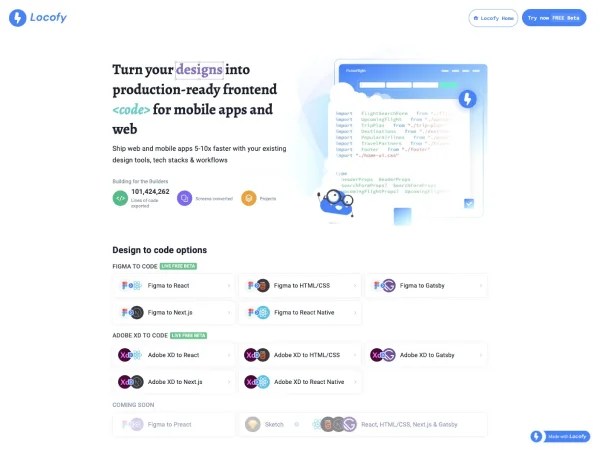
DevelopmentLocofy is a tool that converts design files into frontend code, supports web and mobile app development, and can be used with technology stacks such as React, React Native, and Next.js.
About
Overview
Locofy is an AI design-to-code tool for the frontend development workflow, mainly used to convert interface design files in Figma and Penpot into frontend code that can continue to be developed. It is suitable for collaboration between designers and frontend engineers, helping teams reduce the workload of repeatedly building interfaces and move more quickly from the design stage to the development stage.
Locofy supports generating code for a variety of technology stacks, including React, React Native, HTML/CSS, Next.js, Flutter, Vue, Angular, and can also be used for web and mobile application projects. Compared with simply exporting static code, it places more emphasis on being "developer-friendly," supporting structured processing of layers, creation of reusable components, and improving code maintainability through property configuration. Information on the official website shows that Locofy provides cloud deployment, also supports on-prem deployment, and has SOC2 and ISO related certifications.
Key Features
-
Design to code
- Convert Figma and Penpot design files into frontend code
- Can be used for web and mobile interface development
-
Supports multiple frontend technology stacks
- React
- React Native
- HTML/CSS
- Next.js
- Flutter
- Vue
- Angular
-
Component-based generation
- Supports creating reusable components
- Helps reduce the manual work of building repeated page structures
-
Props and structured processing
- Props can be added to components
- Improves the flexibility and subsequent maintainability of generated code
-
AI-assisted layer tagging
- Uses LocoAI to recognize and label design layers
- Helps generate a clearer code structure that is more suitable for engineering use
-
Suitable for collaborative scenarios
- Suitable for handoff between designers and developers
- Can be used for prototype implementation, basic page generation, and initial frontend development
-
Deployment methods
- Supports cloud usage
- Supports on-prem deployment
Product Pricing
The content captured from the official website does not provide clear public pricing information. Locofy may offer different plans based on team size, usage needs, or deployment method. For specific pricing, it is recommended to refer to the latest page on the official website.
Frequently Asked Questions
Who is Locofy suitable for?
It is suitable for teams that need to quickly turn design files into frontend code, especially product designers, UI designers, frontend engineers, and R&D teams that want to improve design delivery efficiency.
Which design tools does Locofy support?
According to the latest information on the official website, Locofy supports Figma and Penpot. Past materials also mentioned Adobe XD-related capabilities, but whether this is still within the current official key support scope is best confirmed based on the official website's explanation.
Can the generated code be used directly in projects?
The code generated by Locofy is frontend code intended for developers, and is suitable as a page skeleton, initial component draft, or prototype foundation. In actual production projects, developers usually still need to further refine it in combination with business logic, state management, and APIs.
Does Locofy support enterprise use?
Yes. The official website shows that it has SOC2 + ISO certifications and supports on-prem deployment, so it has a certain degree of suitability for teams with compliance, security, or privatization requirements.
Related Tools
View allLiner.ai is a tool that lets users build and deploy machine learning models without programming, suitable for users without a machine learning background to quickly turn training data into integrable models.
Pico is a GPT-4-based text-to-app tool that lets users quickly create simple web applications by describing their needs in natural language, making it suitable for people who have product ideas but do not have programming skills.
Imagica is a no-code AI application development platform that supports users in building AI applications without writing code, and combines real-time data with multimodal capabilities to complete interactive product design.
WidgetsAI is a no-code widget platform for building AI applications, supporting the creation, embedding, and white-labeling of AI components, suitable for teams or individuals who want to quickly integrate AI capabilities without programming.
ComfyUI is a modular graphical interface tool for Stable Diffusion that uses a node-based workflow design, making it easier for users to control the image generation process in greater detail.
Lightning AI is a development framework for building and deploying models and full-stack AI applications, providing capabilities such as training, serving, and hyperparameter optimization to help developers reduce infrastructure configuration work.