
Magick
DevelopmentMagick is a low-code development tool for integrating artificial intelligence capabilities into applications, helping developers and beginners build AI applications more conveniently and lowering the barriers to getting started and deployment.
About
Overview
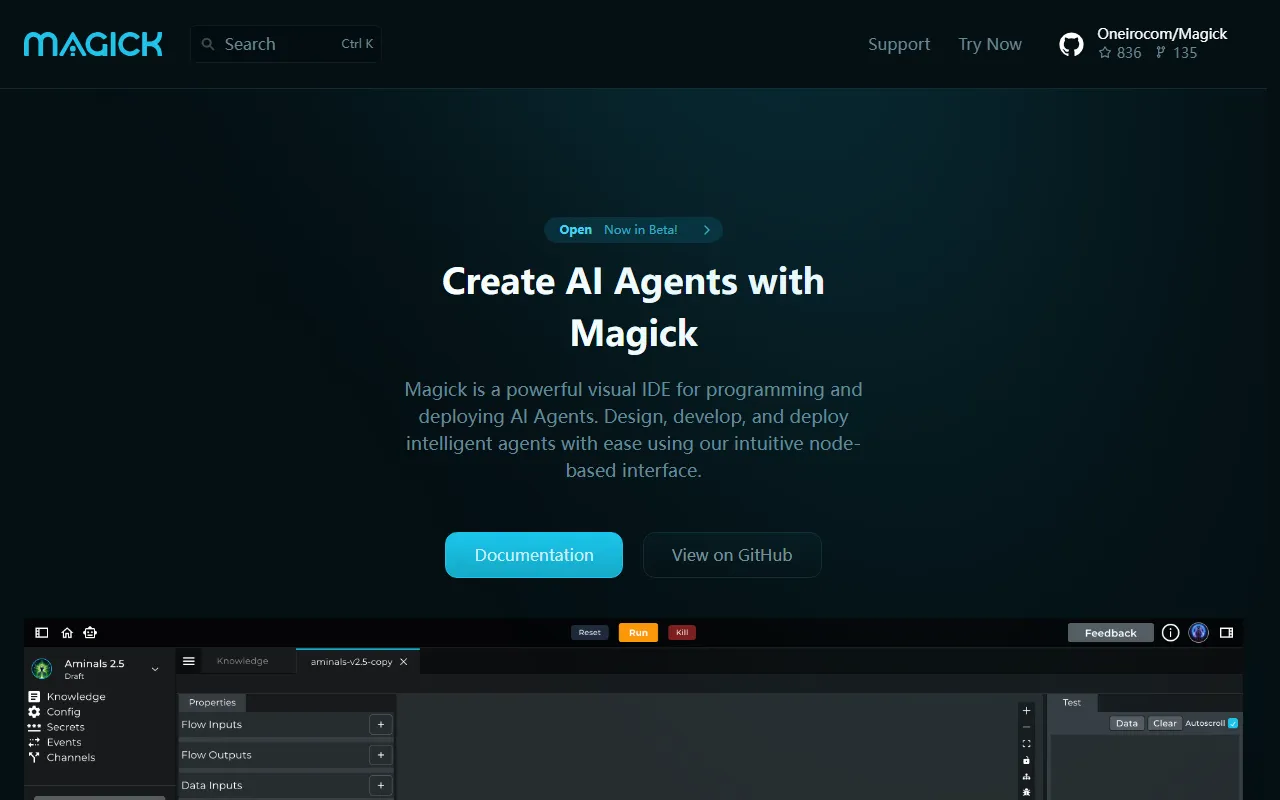
Magick is a low-code visual IDE for AI development and programming scenarios, mainly used to create, orchestrate, and deploy AI Agents. The product emphasizes lowering the barrier to AI application development through a node-based workflow interface, enabling developers, product teams, and beginners to complete the process from prototyping to deployment more quickly.
Based on the information on the official website, Magick’s core features lie in visual building, freely selectable models, support for document processing, and convenient rapid prototype validation. It is suitable both for teams that want to reduce investment in underlying infrastructure and for users who need to quickly test AI interaction logic, build internal tools, or validate business scenarios. At the same time, Magick also offers open-source attributes, making it convenient for developers to extend and customize according to their needs.
Key Features
-
Visual AI Agent Development
- Provides a node-based interface, supporting the design of AI workflows through dragging and connecting nodes.
- Can transform complex agent logic into more intuitive flows, reducing the need for handwritten code.
-
AI Agent Deployment Capabilities
- Supports not only design and development, but also putting built AI agents into use.
- Suitable for a continuous development process from prototype to practical application.
-
Platform-Agnostic Model Integration
- Supports freely choosing different large language models.
- The official website mentions the ability to integrate and compare solutions such as GPT-4, Claude, and open-source models, making it easier to choose the right model for the task.
-
Document and Data Processing
- Can process complex documents and datasets.
- Supports information extraction, content summarization, and generating answers based on embedded knowledge, making it suitable for knowledge-based AI assistant scenarios.
-
Rapid Prototype Validation
- Makes it convenient to quickly test ideas, iterate on designs, and adjust agent behavior in real time.
- Helps shorten the cycle from concept to runnable prototype for AI products.
-
Deep Customization and Extension
- Supports creating custom nodes and adjusting agent capabilities according to specific needs.
- Combined with its open-source nature, it is suitable for teams with secondary development needs.
-
Open-Source Community Support
- Provides a GitHub entry point and has a community-driven development model.
- Convenient for developers to contribute, extend features, or self-deploy.
Product Pricing
The information currently captured from the official website explicitly mentions "Open Now in Beta", indicating that the product is currently in the Beta testing stage.
No clear public pricing page or plan details have been seen in the information provided so far. It is recommended to visit the official website to learn about the latest testing eligibility, deployment methods, and subsequent commercialization plans.
Frequently Asked Questions
Who is Magick suitable for?
It is suitable for developers, product managers, technical teams who want to quickly build AI Agents, as well as beginners who want to try AI applications through a low-code approach.
Does Magick require coding?
According to the official website description, Magick provides a visual node editor, and many workflows can be completed through drag-and-drop; however, for deeper customization needs, developers can still use it in combination with custom extension capabilities.
Which models does Magick support?
The official website shows that it has platform-agnostic characteristics and can connect to GPT-4, Claude, and some open-source models. The specific scope of support is subject to the official documentation and actual integration methods.
Is Magick suitable for knowledge base or document Q&A applications?
Yes. It provides document processing and the ability to generate answers based on embedded knowledge, which can be used to build AI assistants with domain knowledge or internal knowledge applications.
Related Tools
View allLiner.ai is a tool that lets users build and deploy machine learning models without programming, suitable for users without a machine learning background to quickly turn training data into integrable models.
Pico is a GPT-4-based text-to-app tool that lets users quickly create simple web applications by describing their needs in natural language, making it suitable for people who have product ideas but do not have programming skills.
Imagica is a no-code AI application development platform that supports users in building AI applications without writing code, and combines real-time data with multimodal capabilities to complete interactive product design.
WidgetsAI is a no-code widget platform for building AI applications, supporting the creation, embedding, and white-labeling of AI components, suitable for teams or individuals who want to quickly integrate AI capabilities without programming.
ComfyUI is a modular graphical interface tool for Stable Diffusion that uses a node-based workflow design, making it easier for users to control the image generation process in greater detail.
Lightning AI is a development framework for building and deploying models and full-stack AI applications, providing capabilities such as training, serving, and hyperparameter optimization to help developers reduce infrastructure configuration work.