
Minigpt
DevelopmentMiniGPT-4 is an open-source multimodal image-text generation model based on the Vicuna-related architecture. It can understand images and generate text content, making it suitable for research and experimental scenarios such as image description and visual question answering.
About
Overview
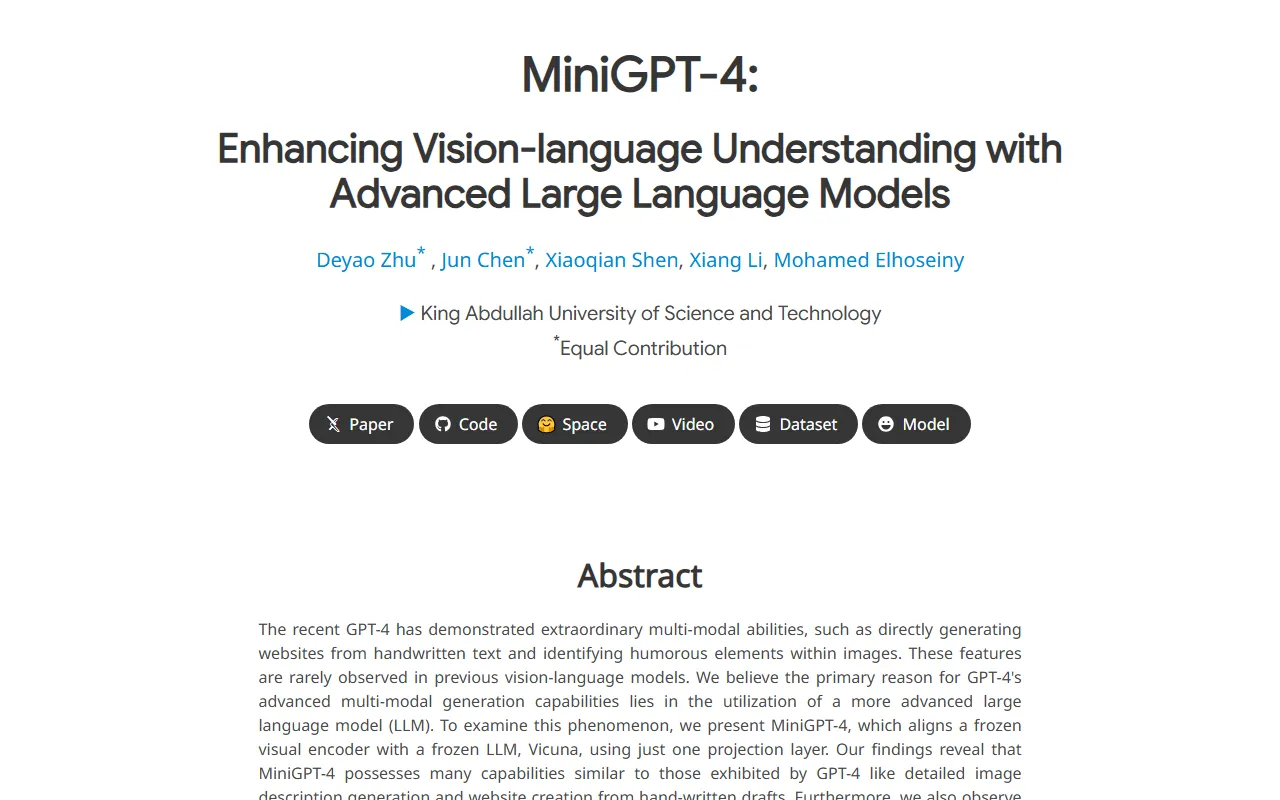
MiniGPT-4 is an open-source multimodal vision-language model positioned for AI Development & Programming scenarios, mainly aimed at researchers, developers, and explorers of multimodal applications. By aligning a frozen visual encoder with the large language model Vicuna, it achieves understanding of image content and outputs relatively natural text results.
The core goal of the project is to reproduce some capabilities of advanced multimodal models in a relatively lightweight way. According to the official introduction, MiniGPT-4 connects the visual module and the language model through only one projection layer, making it more efficient in terms of computational cost. It can handle mixed image and text inputs, making it suitable for scenarios such as visual understanding experiments, prototype validation, and multimodal dialogue research.
Unlike mature products aimed at ordinary users, MiniGPT-4 is more oriented toward research and experimental use. It demonstrates capabilities such as image caption generation, visual question answering, and generating webpage ideas based on sketches, but overall it is more suitable as a foundational component for open-source model research and application development.
Main Features
-
Image Understanding and Text Generation
It can identify the main subjects, scenes, and details in input images, and generate relatively detailed text descriptions. -
Visual Question Answering
It supports question answering based on image content, making it suitable for tasks such as image content analysis and research on experimental dialogue systems. -
Processing of Mixed Image-Text Inputs
It can receive both images and text prompts at the same time, and complete description, explanation, or extended generation under contextual conditions. -
Image-Based Creative Text Generation
The official demonstrations show capabilities such as writing stories and poems based on images, making it suitable for exploring multimodal content generation. -
Experimental Capability from Sketch to Webpage Prototype
The project demonstrates an application approach for assisting in generating webpage content from handwritten drafts, making it suitable for cutting-edge interaction and multimodal prototype research. -
Image Problem Solving and Task Assistance
In some examples, the model can explain problems in images and provide solution ideas, such as offering cooking suggestions based on food photos. -
Open Source and Strong Research Value
It is suitable for model architecture research, data alignment experiments, inference deployment testing, and secondary development of multimodal applications.
Pricing
MiniGPT-4 is an open-source project. Its official website and project pages mainly provide model introductions, research notes, and related code resources.
As of the current public information, no official commercial subscription pricing information has been found. Actual usage costs usually depend on the computing resources, model version, and runtime environment used when developers deploy it themselves.
FAQ
Who is MiniGPT-4 suitable for?
It is mainly suitable for AI researchers, algorithm engineers, developers, and teams that want to explore the capabilities of vision-language models. It is not a typical one-stop product aimed at ordinary consumers.
What types of tasks can MiniGPT-4 handle?
Common tasks include image description, visual question answering, image-text dialogue, creative writing, and multimodal prototype validation.
Is it the same as mature commercial multimodal products?
Not exactly. MiniGPT-4 is more oriented toward open-source research and experimental validation. Although it demonstrates some capabilities close to advanced multimodal models, developers usually still need to optimize it themselves in terms of stability, product experience, and generality.
Is it suitable for direct use in production environments?
It is more suitable as a research foundation or prototype solution. If used in production environments, it usually needs to be fine-tuned, evaluated, and engineered according to specific business scenarios.
Related Tools
View allLiner.ai is a tool that lets users build and deploy machine learning models without programming, suitable for users without a machine learning background to quickly turn training data into integrable models.
Pico is a GPT-4-based text-to-app tool that lets users quickly create simple web applications by describing their needs in natural language, making it suitable for people who have product ideas but do not have programming skills.
Imagica is a no-code AI application development platform that supports users in building AI applications without writing code, and combines real-time data with multimodal capabilities to complete interactive product design.
WidgetsAI is a no-code widget platform for building AI applications, supporting the creation, embedding, and white-labeling of AI components, suitable for teams or individuals who want to quickly integrate AI capabilities without programming.
ComfyUI is a modular graphical interface tool for Stable Diffusion that uses a node-based workflow design, making it easier for users to control the image generation process in greater detail.
Lightning AI is a development framework for building and deploying models and full-stack AI applications, providing capabilities such as training, serving, and hyperparameter optimization to help developers reduce infrastructure configuration work.