
MixPeek
DevelopmentMixPeek is an intelligent search layer built on top of object storage. Through APIs, it can extract, index, and perform natural language search on non-text files, helping applications quickly gain search-engine-like file retrieval capabilities.
About
Overview
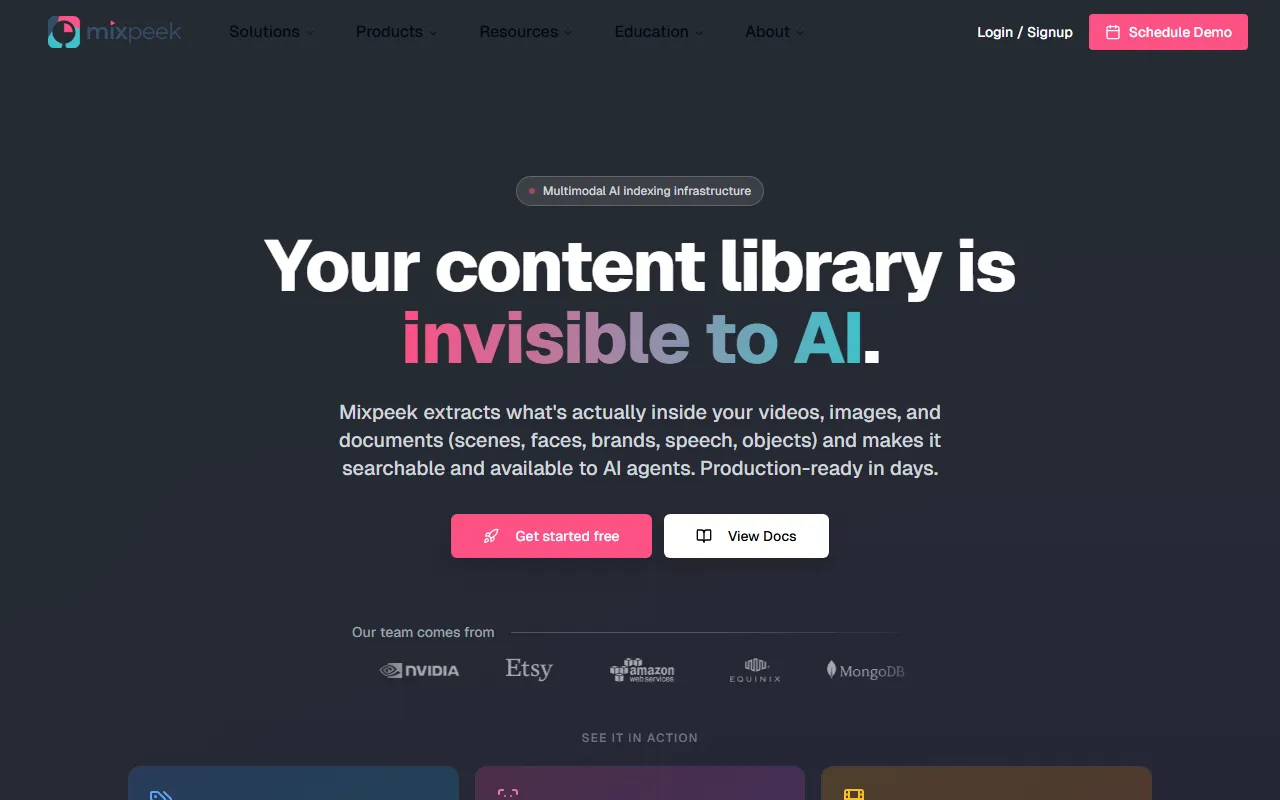
MixPeek is a multimodal AI indexing infrastructure for developers, primarily used to give files in object storage the ability to be "understood and searched by AI." It can connect to object storage such as S3, extract, index, and retrieve unstructured content such as videos, images, documents, and audio, and integrate it into applications, search systems, or AI Agent workflows through APIs.
Unlike traditional solutions that only support text retrieval, MixPeek emphasizes understanding the file content itself, such as identifying scenes, speech, people, brands, and objects in videos, or locating specific content positions such as document pages and video frames. Developers can use it to add natural language search, content retrieval, knowledge discovery, and multimodal context recall capabilities to products more quickly.
Main Features
-
Multimodal content extraction and indexing
- Supports extracting searchable information from files such as videos, images, and documents.
- Can identify and structurally process content such as scenes, speech, people, brands, and objects.
-
Natural language search
- Supports using natural language to search videos, audio, images, and documents.
- Search results can be linked to more fine-grained locations, such as specific scenes, pages, or frames.
-
Context retrieval for AI Agents
- Provides multimodal context for large models or AI Agents.
- Can return structured information such as relevant video clips, image regions, and transcription text in a single API call.
-
Pattern discovery and content analysis
- Discovers content patterns that are difficult for humans to identify quickly through classification, clustering, and other methods.
- Can be used to identify cross-material appearances of faces, repeated themes, similar scenes, and more.
-
API-first development integration
- Provides a REST API and Python SDK.
- Supports deployment in your own environment, suitable for integration into dashboards, application search, content management systems, and intelligent agents.
-
Suitable use cases
- Enterprise internal file and media asset retrieval
- Multimedia content management and knowledge base building
- Development of file search functions for end users
- Multimodal retrieval enhancement in AI applications
Product Pricing
The official website currently displays "Get started free," indicating that a free way to get started is offered, but the public page does not clearly list detailed plan pricing, usage quotas, or enterprise edition fees.
If you need specific pricing, deployment methods, or self-hosting options, it is recommended to visit the official documentation or contact the official team for the latest information.
Frequently Asked Questions
-
What file types does MixPeek mainly process?
According to the official website, it mainly targets multimodal file content such as videos, images, documents, and audio. -
Is it suitable for developers to integrate into existing systems?
Yes. MixPeek adopts an API-first design, supports a REST API and Python SDK, and can be used for integration into applications, dashboards, or AI Agent systems. -
How is it different from ordinary file search?
Ordinary search usually relies on file names, tags, or plain text content; MixPeek places more emphasis on understanding the content inside files, such as speech in videos, visual elements, and scene-level retrieval. -
Does it support self-deployment?
The official website summary mentions support for self-hosted, indicating that self-hosting options are available, but specific deployment requirements need to be referenced in the official documentation. -
What teams is it suitable for?
It is suitable for development and product teams that need to manage large amounts of multimedia content, build intelligent retrieval systems, or want AI Agents to access file content context.
Related Tools
View allLiner.ai is a tool that lets users build and deploy machine learning models without programming, suitable for users without a machine learning background to quickly turn training data into integrable models.
Pico is a GPT-4-based text-to-app tool that lets users quickly create simple web applications by describing their needs in natural language, making it suitable for people who have product ideas but do not have programming skills.
Imagica is a no-code AI application development platform that supports users in building AI applications without writing code, and combines real-time data with multimodal capabilities to complete interactive product design.
WidgetsAI is a no-code widget platform for building AI applications, supporting the creation, embedding, and white-labeling of AI components, suitable for teams or individuals who want to quickly integrate AI capabilities without programming.
ComfyUI is a modular graphical interface tool for Stable Diffusion that uses a node-based workflow design, making it easier for users to control the image generation process in greater detail.
Lightning AI is a development framework for building and deploying models and full-stack AI applications, providing capabilities such as training, serving, and hyperparameter optimization to help developers reduce infrastructure configuration work.