
MLX
DevelopmentMLX is an array framework for machine learning introduced by Apple's machine learning research team. This open-source framework is designed and optimized for Apple Silicon chips, drawing inspiration from frameworks such as NumPy, PyTorch, Jax, and ArrayFire. It provides a simple and user-friendly way to help developers efficiently develop, train, and deploy models on Apple's M-series chips.
About
Overview
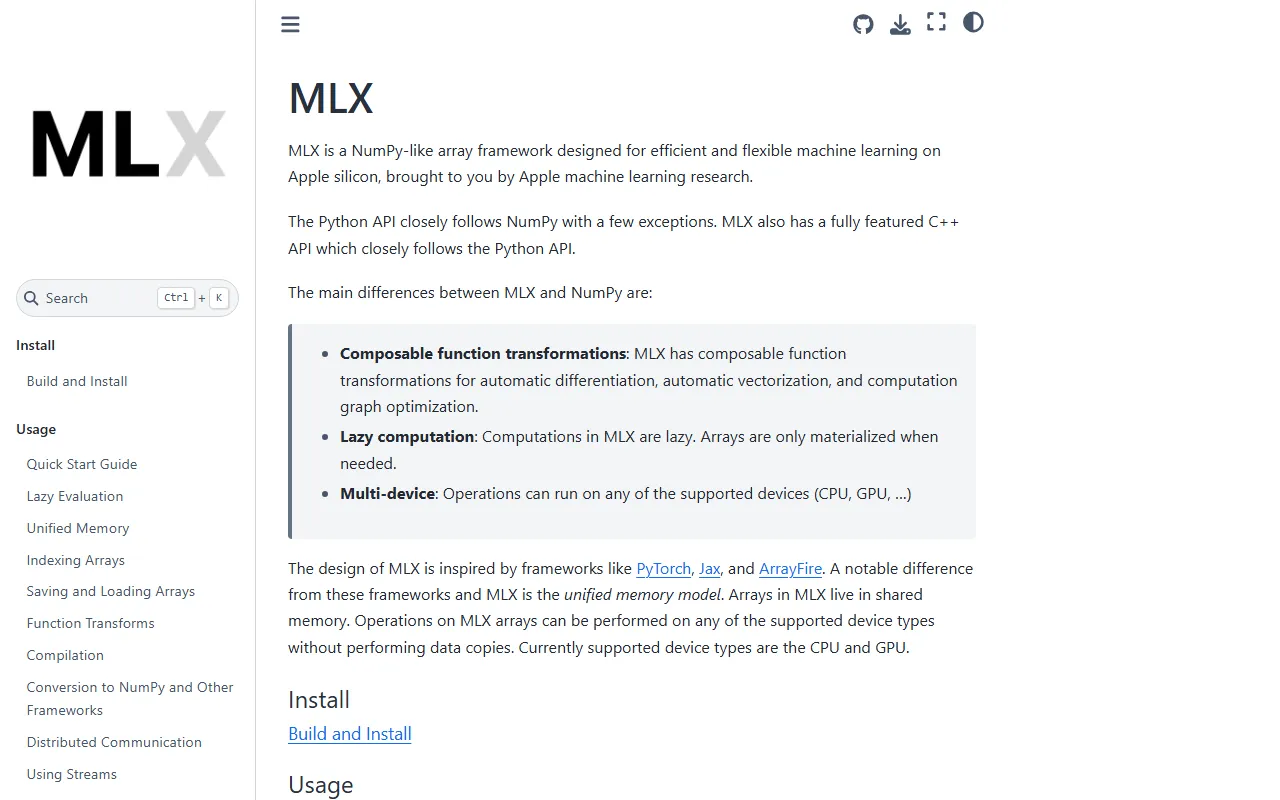
MLX is an open-source array framework introduced by Apple's machine learning research team, optimized specifically for Apple Silicon and suitable for machine learning development, training, and deployment on Mac M-series chips. Its design style is close to NumPy, while also drawing on ideas from frameworks such as PyTorch, JAX, and ArrayFire, balancing ease of use and flexibility.
The core features of MLX are: support for automatic differentiation, automatic vectorization, lazy computation, and dynamic computation graphs, while providing a Python API and a fully featured C++ API. Unlike many frameworks, MLX uses a unified memory model, allowing the CPU and GPU to share array data, reducing the overhead of data copying between devices and making it better suited to the hardware architecture of Apple Silicon.
Main Features
-
NumPy-style API
- The Python interface is highly similar to NumPy, making it easy for scientific computing and machine learning developers to get started quickly.
- It also provides a C++ API with a style close to Python, suitable for high-performance scenarios.
-
Composable function transformations
- Supports automatic differentiation (autodiff)
- Supports automatic vectorization
- Supports computation graph optimization
-
Lazy computation
- Computation is deferred by default and is only materialized when results are actually needed, helping optimize execution efficiency.
-
Dynamic computation graphs
- Computation graphs are built dynamically at runtime, making debugging more direct.
- Changes in input shapes usually do not trigger complex and slow recompilation processes.
-
Multi-device execution
- Operations can be executed on supported devices, currently mainly including CPU and GPU.
-
Unified memory model
- Arrays reside in shared memory, and the CPU and GPU can directly access the same data, reducing the cost of data movement.
Product Pricing
MLX is an open-source and free framework. Official documentation and a GitHub repository are provided, making it suitable for individual developers, researchers, and enterprise teams.
- Official documentation: https://ml-explore.github.io/mlx/build/html/index.html
- GitHub: https://github.com/ml-explore/mlx
Frequently Asked Questions
Who is MLX suitable for?
It is suitable for developers conducting machine learning research, model prototyping, deep learning training, and scientific computing on Apple chip devices, especially users familiar with NumPy, PyTorch, or JAX.
What is the difference between MLX and NumPy?
MLX retains an array programming experience similar to NumPy, but additionally provides capabilities required for machine learning, such as automatic differentiation, automatic vectorization, lazy execution, and multi-device support.
What hardware does MLX support?
It currently focuses on supporting CPU and GPU in Apple Silicon environments and has been optimized for Apple chips.
Can MLX be used for model training?
Yes. MLX can be used to build training workflows, perform tensor operations, carry out gradient computation, and optimize models, making it suitable for machine learning and deep learning experiments.
Related Tools
View allLiner.ai is a tool that lets users build and deploy machine learning models without programming, suitable for users without a machine learning background to quickly turn training data into integrable models.
Pico is a GPT-4-based text-to-app tool that lets users quickly create simple web applications by describing their needs in natural language, making it suitable for people who have product ideas but do not have programming skills.
Imagica is a no-code AI application development platform that supports users in building AI applications without writing code, and combines real-time data with multimodal capabilities to complete interactive product design.
WidgetsAI is a no-code widget platform for building AI applications, supporting the creation, embedding, and white-labeling of AI components, suitable for teams or individuals who want to quickly integrate AI capabilities without programming.
ComfyUI is a modular graphical interface tool for Stable Diffusion that uses a node-based workflow design, making it easier for users to control the image generation process in greater detail.
Lightning AI is a development framework for building and deploying models and full-stack AI applications, providing capabilities such as training, serving, and hyperparameter optimization to help developers reduce infrastructure configuration work.