
Qdrant Vector Database
DevelopmentQdrant Vector Database is an open-source vector database and search engine focused on efficient vector similarity retrieval. It supports the development of embedding-vector-based applications such as search, matching, and recommendations through APIs.
About
Overview
Qdrant Vector Database is an open-source vector database and vector search engine built with Rust, designed for AI application scenarios that require high-performance similarity retrieval. It is mainly used to store, index, and retrieve high-dimensional vector data, and provides capabilities such as search, matching, and recommendations through APIs, making it easy for developers to integrate it into systems such as semantic search, retrieval-augmented generation (RAG), recommendation systems, image retrieval, and intelligent matching.
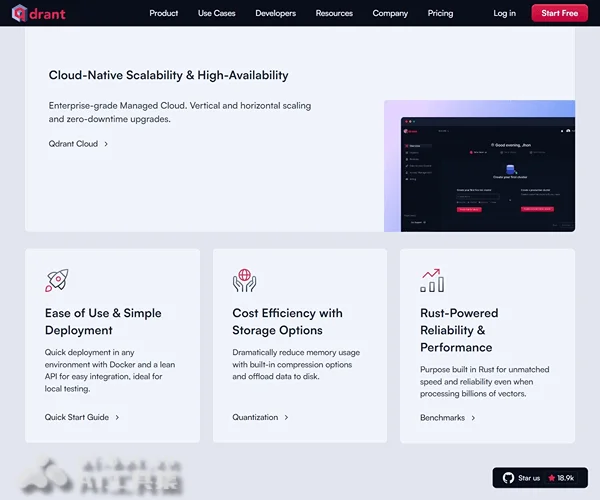
Qdrant supports large-scale vector retrieval in production environments. It can handle both dense vectors generated by embedding models and hybrid search combined with keyword capabilities. According to the official website, the product emphasizes scalability, real-time retrieval performance, rich metadata filtering capabilities, and vector search services suitable for multiple deployment methods.
Key Features
-
High-performance vector similarity search
- Supports the storage, indexing, and retrieval of high-dimensional vectors
- Provides approximate nearest neighbor search capabilities, suitable for low-latency semantic retrieval scenarios
- Supports common vector retrieval technical approaches such as KNN and HNSW
-
API-friendly integration methods
- Provides easy-to-access APIs, suitable for integration with various AI applications and backend services
- Can be used to implement functions such as search, recall, recommendations, and similar content matching
-
Native hybrid retrieval
- Supports dense + sparse hybrid search
- Can combine vector retrieval and keyword retrieval in the same query
- The official website mentions support for methods such as BM25, SPLADE++, and miniCOIL
-
Rich metadata filtering
- Supports storing metadata in JSON
- Supports advanced filtering such as nested fields, text, geolocation, and has_vector
- The filtering process can be executed together with the retrieval workflow, making it suitable for recall control under complex conditions
-
Multi-vector and reranking capabilities
- Supports associating multiple vectors with one object, improving expressiveness in multimodal and complex retrieval scenarios
- Supports score boosting based on business rules, as well as reranking approaches such as MMR and late interaction
-
Compatible with mainstream embedding models
- Can be used with vectors generated by models such as BERT, Transformer, word2vec, and fastText
- Suitable for building semantic search, content discovery, intelligent recommendation, and matching systems
Product Pricing
The official website shows that Qdrant Cloud is available and provides a "Start Free" entry, indicating that the product includes a cloud service option that can be started for free.
More detailed pricing, resource specifications, enterprise edition, or self-hosting costs are not shown in the currently provided information. If you need to confirm, it is recommended to visit the official pricing or cloud service page to view the latest information.
FAQ
-
Is Qdrant open source?
Yes. The official website clearly states that Qdrant is an open-source vector search engine. -
What scenarios is Qdrant suitable for?
It is suitable for scenarios such as semantic search, RAG retrieval layers, recommendation systems, image search, similar content matching, and multimodal retrieval. -
Does Qdrant support hybrid search?
Yes. The official website mentions that it has native hybrid search capabilities and can combine dense and sparse vectors for retrieval. -
Does Qdrant support metadata filtering?
Yes, and it provides a relatively rich set of filter types, including nested fields, text, and geolocation. -
How can Qdrant be deployed?
Based on the official website information, it supports both cloud-based options and emphasizes compatibility with multiple deployment modes; at the same time, its open-source nature also makes it suitable for self-hosting.
Related Tools
View allLiner.ai is a tool that lets users build and deploy machine learning models without programming, suitable for users without a machine learning background to quickly turn training data into integrable models.
Pico is a GPT-4-based text-to-app tool that lets users quickly create simple web applications by describing their needs in natural language, making it suitable for people who have product ideas but do not have programming skills.
Imagica is a no-code AI application development platform that supports users in building AI applications without writing code, and combines real-time data with multimodal capabilities to complete interactive product design.
WidgetsAI is a no-code widget platform for building AI applications, supporting the creation, embedding, and white-labeling of AI components, suitable for teams or individuals who want to quickly integrate AI capabilities without programming.
ComfyUI is a modular graphical interface tool for Stable Diffusion that uses a node-based workflow design, making it easier for users to control the image generation process in greater detail.
Lightning AI is a development framework for building and deploying models and full-stack AI applications, providing capabilities such as training, serving, and hyperparameter optimization to help developers reduce infrastructure configuration work.